
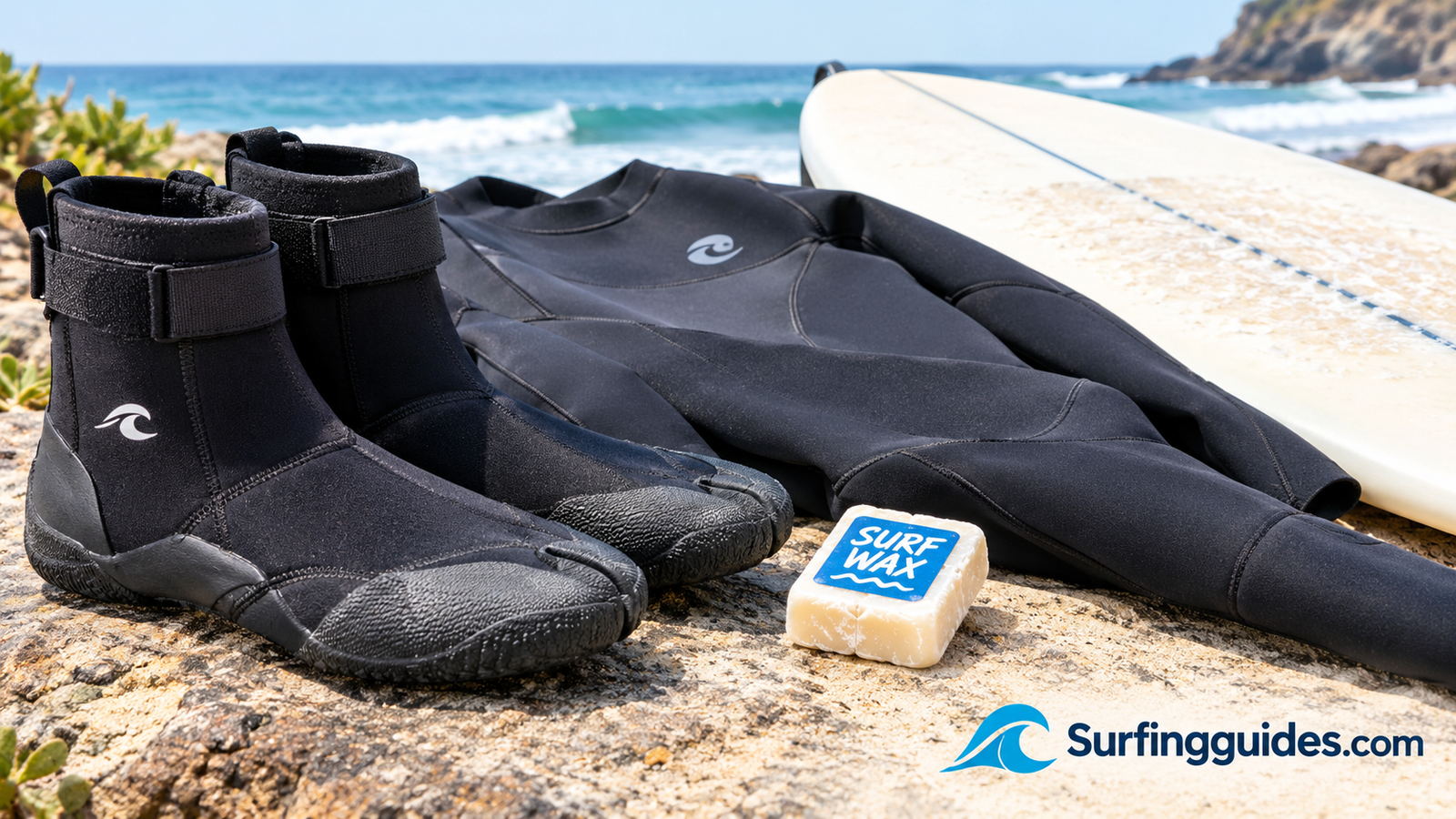
Best Surfing Booties: Warm, Grippy Picks for Every Break and Budget
Numb toes end sessions early. The right pair of surf booties keeps your feet warm, protects them from reef and rock, and lets you stay in the water until the waves quit instead of your circulation.
Why this guide exists
Anyone who has paddled out on a cold morning knows the moment. Your hands are fine, your core is warm inside the wetsuit, and then your feet go from tingling to wooden. You lose the feeling of the board under them, you pop up a half-second late, and a session you drove an hour for ends after thirty minutes.
Surf booties solve that problem, and they solve a few others you might not have thought about: sharp reef, barnacle-covered rocks, hot sand, and the slippery walk down a boat ramp or jetty. But the category is more confusing than it looks. Thickness, toe design, sole type, seam construction and sizing all change how a bootie feels in the water, and the wrong choice can leave you with cold feet, cramped toes, or a boot that fills with water every time you duck-dive.
We went through ten popular options, from slim split-toe booties designed for feel to heavy-duty five millimeter boots built for freezing water. Below you will find a quick comparison, a plain-English buying guide, detailed reviews with honest pros and cons, and answers to the questions surfers ask most. If you are still piecing together your whole setup, our guide on what to wear surfing covers the layers that work alongside your booties.
One more point before we dive in: there is no single perfect bootie for everyone. A surfer in a cold northern bay and a surfer at a reef point in cool but not freezing water have very different needs, and a good guide should help you work out which of those describes you. We have tried to be honest about trade-offs, because every bootie gives something up to gain something else. Thinner means more feel and less warmth, thicker means more warmth and less feel, and tougher soles mean more protection and less sensitivity. Once you know which of those you care about most, choosing becomes simple.
Want to browse current prices and sizes before you read on?
Browse surfing booties on Amazon
Quick picks at a glance
If you just want a shortlist, start here. Each of these is reviewed in full further down, so you can jump to any pick that catches your eye.
| Bootie | Thickness | Toe style | Best for |
|---|---|---|---|
| O’Neill Heat 3mm Split Toe | 3mm | Split | Board feel in cool water |
| O’Neill Heat 5mm Round Toe | 5mm | Round | All-round cold-water warmth |
| Xcel Drylock 3mm Split Toe | 3mm | Split | Sealed, low-flush fit |
| Rip Curl Flashbomb Booties | Warm-water to cold-water options | See listing | Performance surfers who want quick-drying neoprene |
| Patagonia R3 Yulex Split Toe | 3mm class | Split | Surfers who care about materials |
| O’Neill Psycho Tech | Premium build | See listing | Top-end insulation and flexibility |
| Ho Stevie! 5mm | 5mm | Round | Budget-friendly warmth |
| Cressi Minorca 5mm | 5mm | Round | Rocky entries and sturdy soles |
| Quiksilver Everyday Sessions 5mm Round Toe | 5mm | Round | Everyday cold-water sessions |
| Sea to Summit Ultraflex Booties | Flexible neoprene build | See listing | Travel-friendly packability |
How we looked at each bootie
Rather than ranking these booties on a single score, we looked at the things surfers actually care about once they are in the water. Warmth came first, judged by thickness, seam design and how well the cuff limits water entry. Board feel came next, which depends on sole thickness, toe design and how flexible the neoprene is. We then considered protection from rock and reef, ease of getting them on and off, how the fit works for different feet, and how well each one is likely to hold up over several seasons.
Price also matters, but we treated it as context rather than a verdict. A premium bootie is only good value if you will use what you are paying for, while a budget bootie can be a bargain for the right surfer and a false economy for the wrong one. Because retailers change prices and versions regularly, we point you to the live listing for each product so you can check current details yourself.
For most surfers in genuinely cold water, the O’Neill Heat 5mm Round Toe is the safest all-round choice. If you care about feeling your board, the O’Neill Heat 3mm Split Toe or the Xcel Drylock 3mm Split Toe are better places to start.
See today’s prices on the most popular surf booties.
Check prices on AmazonWhy surfers wear booties in the first place
Booties are one of those pieces of gear that new surfers often skip and experienced surfers refuse to leave home without. The reasons stack up quickly once you spend a winter in the water.
Warmth where you lose it fastest
Your feet sit at the far end of your circulatory system and spend most of a session either dangling in cold water or pressed against a cold, wet board deck. Blood flow to your extremities drops as your body protects its core, which is why feet are usually the first thing to go numb. A neoprene bootie traps a thin layer of water against your skin that your body warms up, exactly like the wetsuit on the rest of you. The result is a noticeable difference in how long you can stay out.
Protection from the places waves break
Not every surf spot is a clean sandy beach. Reef breaks, point breaks and jetty setups all involve getting in and out over rock, coral, barnacles or sea urchins. A cut on the sole of your foot is more than an annoyance, because it can cost you weeks out of the water. Even at a sandy beach, rocks and broken shells hide in the shallows, and hot sand in summer can be brutal on bare feet. A bootie with a proper sole gives you a layer of defence on the walk in and the walk out.
Better board control than you would expect
It sounds backwards, but cold feet make you a worse surfer. When you cannot feel your toes, your stance gets lazy, your pop-up slows, and you lose the tiny weight shifts that keep you balanced on a wave. Warm feet stay responsive. Thin split-toe designs are built specifically to preserve board feel while still keeping the chill out.
Who really benefits
Anyone surfing water below the low sixties Fahrenheit will feel the difference. Surfers at rocky or reef-heavy spots benefit regardless of temperature. Travelling surfers who chase cold-water points, anyone with poor circulation, and people who simply want longer sessions are all good candidates. If you are brand new and still working out your basic setup, read our beginner’s guide to starting surfing first, then come back to add booties once you know where you will be paddling out.
When you can skip them
If you surf in genuinely warm tropical water over soft sandy bottoms, booties are optional. Many surfers in those conditions go barefoot and rely on wax and tough skin. The moment the water gets chilly, or the entry gets rocky, that changes.
If you would reach for a full-length wetsuit, you should at least consider booties. If you would reach for a hooded wetsuit, you almost certainly want them.
The safety side of keeping your feet warm
Cold does more than make you uncomfortable. As your feet and hands cool, coordination drops and your reaction time slows, which matters when you are dodging a closing-out wave or stepping across a slippery rock shelf. Surfers who stay warm make cleaner decisions, and clean decisions are what keep a good session from turning into a bad one. A warm bootie will not make you invincible, but it removes one reason things go wrong in cold conditions.
There is also the exit to think about. After a long session your feet are tired and partly numb, and the walk back over stones, steps or a boat ramp is often where people slip. A grippy sole under cold feet is a quiet but real safety upgrade.
Common myths about surf booties
“Booties ruin your feel for the board.” Thick, stiff boots can dull it, but thin split-toe designs keep much of your sensitivity, and many surfers find they ride better because their feet are not numb.
“They only matter in winter.” Reef, rocks and hot sand are year-round hazards, so protection can matter even when the water is mild.
“Any neoprene sock will do.” Surf booties are designed with grip, sealing and durability in mind. A thin casual sock may keep the chill off briefly but tends to wear out fast and flush with water.
“Thicker is always better.” Past a point, extra thickness costs you balance and comfort. The goal is the thinnest bootie that keeps you warm, not the thickest you can find.
Ready to compare options that match your water temperature?
Shop cold-water surf bootiesChoosing the right thickness
Thickness is the single biggest factor in how warm a bootie feels, and it is also where most people either overspend on warmth they do not need or underbuy and regret it halfway through a session. Neoprene thickness is measured in millimetres, and the number you see on a product listing is the main body panel thickness.
Lighter booties: 1mm to 2mm
These are warm-weather or shoulder-season booties. They take the edge off cool water, protect your soles, and weigh almost nothing. They are also the best option if you mainly want reef protection rather than insulation. Expect them to feel cold quickly when the water drops below the mid sixties.
The middle ground: 3mm
A 3mm bootie is the sweet spot for many surfers because it balances warmth with dexterity. You still get decent board feel, and the neoprene is flexible enough to crouch and pop up without fighting the material. This is the thickness found in several of our picks, including the O’Neill Heat 3mm Split Toe, the Xcel Drylock 3mm Split Toe and the Patagonia R3 Yulex Split Toe. Pair a 3mm bootie with a 3/2mm wetsuit and your whole body feels balanced.
Cold-water standard: 5mm
When the water gets properly cold, 5mm is the point where booties go from comfortable to genuinely protective. The extra neoprene insulates much better but costs you some sensitivity, so you will feel the board a bit less. Many surfers accept that trade without a second thought because numb toes are worse than muffled ones. The O’Neill Heat 5mm Round Toe, Ho Stevie! 5mm, Cressi Minorca 5mm and Quiksilver Everyday Sessions 5mm all live in this category.
Extreme cold: 6mm and 7mm
Winter in cold regions can call for 6mm or 7mm booties. These are more specialised and noticeably bulky. Most surfers do not need them unless they surf in near-freezing conditions, but if you do, thickness matters more than any other feature.
Matching your bootie to your wetsuit
A good rule is to match or slightly exceed your wetsuit’s leg thickness. If you surf in a 4/3mm suit, a 3mm or 5mm bootie makes sense. If you wear a heavy 5/4mm suit with hood and gloves, go with a 5mm bootie or thicker. Mixing a very thick suit with thin booties creates a cold spot at your ankles, and one weak link can ruin an otherwise warm setup. Our guide to the best cold-water wetsuits for surfing pairs well with this section if you are upgrading everything at once.
A rough temperature guide
| Water temperature | Suggested bootie thickness |
|---|---|
| Mid sixties Fahrenheit and above | Optional, or 1 to 2mm for protection |
| Upper fifties to low sixties | 2 to 3mm |
| Low to mid fifties | 3 to 5mm |
| Mid to upper forties | 5mm |
| Low forties and below | 6 to 7mm |
These are starting points. Everyone runs warm or cold differently, and wind chill after a session matters just as much as the water itself.
Why many surfers own two pairs
If you surf through more than one season, a single bootie rarely covers everything. A thin 3mm split-toe pair handles spring and autumn, when you want feel and the water is only a little chilly. A 5mm round-toe pair takes over in winter. Owning both costs more upfront, but each pair lasts longer because it is not being pushed outside its comfortable range, and you end up warmer and happier all year.
If you can only afford one, buy for the coldest conditions you regularly surf. It is much easier to cope with feet that are slightly too warm in October than with feet that are numb in January.
Does thicker always mean warmer?
Mostly, but not always. A well-sealed 3mm bootie can feel warmer than a leaky 5mm one, because water flushing through the cuff removes heat faster than the neoprene can hold it. Fit and sealing matter as much as the number on the label, which is why a thicker bootie with a gap at the ankle can disappoint.
What about warm-water protection booties?
Some surfers wear very thin booties, or soft-soled reef shoes, in warm water purely to protect their feet. In those cases, insulation is irrelevant, and what you want is a grippy, flexible sole that dries quickly and does not hold heat. A 1 to 2mm bootie fits the job nicely. It also keeps sand and coral dust out of the way and makes a sharp walk across a hot car park far more pleasant.
Find a bootie thickness that fits your local water temperature.
Shop 5mm surf bootiesSplit toe vs. round toe: which style suits you?
Look at any serious surf bootie lineup and you will see two main silhouettes. The difference seems cosmetic at first, but it changes how the bootie feels underfoot and how warm your toes stay.
Split toe booties
Split-toe booties separate your big toe from the rest, similar to a tabi sock. That small design change lets your big toe grip the board independently, which many surfers find dramatically improves feel and balance. Because the bootie hugs the foot more closely, it also tends to be lower profile and more flexible.
Pros
- Excellent board feel and grip
- Lower profile and snug
- Great for performance surfing
Cons
- Slightly less warm than round toe at the same thickness
- Can feel odd for the first session
- Fit is less forgiving
Round toe booties
Round-toe booties keep all your toes together in one pocket. Because your toes share warmth, they stay warmer, and because the shape is simpler, the fit tends to be more forgiving. They are also the more familiar choice if you have ever worn a diving boot or a standard wetsuit sock. The trade is a thicker, more cushioned feel under the toes, so you will sense the board less.
Pros
- Warmer toes in cold water
- Forgiving fit for different foot shapes
- Easy to get on and off
Cons
- Less independent big-toe grip
- Bulkier feel under the board
- Can feel clumsy for experienced surfers who prefer sensitivity
How to decide
Ask yourself what bothers you most: cold toes or lost board feel. If you surf in water cold enough to hurt, choose round toe, since warmth is the whole point. If the water is cool rather than freezing and you care about your pop-up and foot placement, go split toe. Plenty of surfers own one of each and swap depending on the season.
Which style works in real situations?
Picture a crisp autumn morning at a sandy beach break, with small clean waves and a long walk across hard-packed sand. A thin split-toe bootie is perfect here, because you will want your pop-up to feel natural and you do not need heavy protection. Now picture a winter dawn at a rocky point, with wind off the water and a scramble over wet stone before you can even paddle. A thicker round-toe boot with a tougher sole is the better partner, since warmth and protection matter more than finesse.
Many surfers also find their preference changes as their skill grows. Beginners often appreciate the cushioning and warmth of round toes while they build confidence. Intermediate and advanced surfers frequently move to split toes once they start caring about subtle foot pressure. Neither is a better choice in absolute terms. They are tools for different jobs.
Getting used to a split toe
The first time you wear a split-toe bootie, the divider between your big toe and the rest feels strange, and some people briefly wonder whether they made a mistake. Give it two or three sessions. Most surfers stop noticing it quickly, and many say they cannot go back. If it still bothers you after a few outings, a round toe is a perfectly good alternative.
Try both styles to see which feels right on your board.
Shop split toe bootiesMaterials, seams and soles: what actually matters
Two booties of the same thickness can feel completely different on your feet. The difference comes down to materials, how the seams are put together, and what sits under your arch.
Neoprene type
Neoprene is not a single material. Traditional petroleum-based neoprene is common and effective. Limestone-based neoprene is generally lighter and more flexible. Natural rubber alternatives, such as the Yulex used by Patagonia, are plant-derived and aimed at surfers who want to cut down on petroleum-based materials without giving up performance. Premium neoprene stretches further, dries faster and keeps its shape longer, but it costs more.
Seam construction
Seams are where water gets in. Cheaper booties use flatlock stitching, which is comfortable and quick to make but lets water seep through. Better booties use glued and blind-stitched seams, where panels are bonded together and stitched only partway through the neoprene, so the needle never creates a path for water. Some also add liquid tape or taped seams at high-stress spots. If warmth matters more than price, look for glued and blind-stitched or sealed construction.
Linings
Thermal linings add warmth and speed up drying. Fleece-style interiors feel soft against the skin and trap heat, but can take longer to dry between sessions. Smooth lined interiors make getting your foot in easier. If you struggle with entry, a slick lining inside the foot and ankle makes a big difference.
Ankle seals and closures
The opening around your ankle is the biggest source of flushing, which is the cold rush of water that runs in and out as you move. Look for internal ankle seals, adjustable straps, or a snug cuff that tucks inside or over your wetsuit leg. Many booties offer a drylock-style or internal flap closure designed to limit flushing. Pair your wetsuit leg over the bootie or tucked inside depending on the design. Mixing these up is a common reason for cold ankles.
Soles
Surf bootie soles range from thin and flexible rubber to stiff, thick, sturdy soles with a pronounced tread. Thin soles preserve feel and are best for sandy beach breaks. Thicker soles protect better on reef, rocks and jetties but reduce sensitivity on the board. Make sure the sole is designed to be comfortable when you press it against a wet, waxed deck, since some very stiff soles can feel awkward under your arch when you pop up.
If you take only one thing from this section, make it seam quality and ankle closure. These two features decide how warm a bootie actually feels far more than a spec-sheet number.
What you get at different price levels
Budget booties generally use simpler neoprene, flatlock seams and plain linings. They keep your feet warmer than bare skin and protect against rocks, which is what many casual surfers need. Mid-range booties add better seam construction, thicker or more refined soles and smarter cuffs, and for most regular surfers this is the sweet spot of price and performance. Premium booties add lighter, stretchier neoprene, sealed or taped seams, and fine-tuned patterns that fit better and last longer.
The practical question is how often you surf in cold water. If you are out most weekends from autumn through spring, spending more on construction pays off in warmth and lifespan. If you surf cold water only a handful of times a year, a budget pair is perfectly sensible.
Reading a product listing
Product pages can be vague, so look for specific words. Terms like glued and blind-stitched, sealed seams or internal cuff tell you how the bootie is built. Vague terms like premium neoprene or ultra-warm tell you very little. When details are missing, customer reviews are often more honest than the description, particularly regarding sizing, flushing and how the bootie holds up after a season.
Compare constructions, linings and sole types side by side.
Compare surf boots on AmazonGetting the fit right
A bootie that fits badly is worse than no bootie. Too loose and it floods with cold water and rubs your heel raw. Too tight and it restricts circulation, which defeats the entire purpose of wearing it. Neoprene is stretchy but not magical, and size charts vary between brands.
What a good fit feels like
You want a snug, close fit around the heel and ankle, with enough room at the toes so they are not crushed against the end of the bootie. There should be no big air pockets or wrinkles in the neoprene, because wrinkles become pressure points and water channels. When you flex your foot, nothing should pinch. You should be able to wiggle your toes without a fight.
Sizing tips
- Measure your foot in the evening, when feet are slightly larger, and compare to the brand’s chart rather than your regular shoe size.
- Check whether the brand runs small or large. Reviews often mention this clearly. Some brands use whole sizes only, so you may need to size up if you are between sizes.
- Consider the thickness. Thicker booties take up more room inside, so if you plan to wear thick socks under them, size accordingly.
- Try them wet if you can. Neoprene feels different once soaked and warmed by your foot, and a bootie that feels perfect dry may loosen slightly in water.
What to wear under your booties
Most surfers wear booties on bare feet. Socks add bulk and absorb water, which can make your feet colder once they are soaked. If you do want extra insulation, thin neoprene socks are a better choice than cotton, which is the worst possible fabric in the water. For a full breakdown of what works under your suit and where, our guide to what to wear under a wetsuit for surfing goes through the layers.
Breaking them in
New booties often feel stiff for the first session or two. Put them on at home, wear them around for ten minutes, and flex your foot to warm the neoprene. Rinse them after each use and they will mould to your foot quickly. If a pair still rubs or pinches after several sessions, it is not the right shape for you. Do not tough it out, since a hot spot on your heel turns into a blister fast.
Pulling them on and off without damage
Neoprene tears when you yank it. Roll the opening down slightly, pull gently on the sides rather than the top edge, and wet your foot if the bootie is clinging. A splash of water or a little wetsuit-friendly lubricant makes entry far easier and extends the life of the seams.
Fit by foot shape
Not every foot is the same, and booties are cut to a general shape. Surfers with wide feet often find that round-toe designs have more room across the forefoot, while narrow feet can suit the closer cut of a split-toe pair. High arches may feel pressure from stiff soles, so look for flexible midsoles. Surfers with a high instep or thick ankles should pay attention to cuff design, since a narrow cuff can pinch or restrict circulation.
If you fall between sizes, think about the way you plan to use the bootie. For cold-water sessions where you might add a thin sock, size up. For warm-water sessions or a split-toe pair that you want to feel snug, stay with the smaller size. Reading recent customer reviews for sizing comments saves a lot of returns.
Signs of a bad fit in the water
Pay attention to your feet in the first ten minutes of a session. A tingling or aching sensation that gets worse usually means the bootie is too tight. A cold gush every time you duck-dive suggests it is too loose or the cuff is not sealing. A rubbing heel suggests the bootie is moving around, which is a sign to try a smaller size or a different brand. Treat your first session as a fitting test, and do not be afraid to swap them if they are not right.
Check size charts and recent reviews before you buy.
See sizes and reviewsReviews: O’Neill Heat and Xcel Drylock
We start with three of the most recognisable names in cold-water surf footwear. Two come from O’Neill’s Heat line, one thin and one thick, and the third is a split-toe design from Xcel that focuses on keeping water out of the boot.

O’Neill Heat 3mm Split Toe
Best for board feel3mmSplit toeThe Heat 3mm Split Toe is the bootie to look at if you care about how your feet connect to the board. The split toe lets your big toe work on its own, and the 3mm neoprene is thin enough that you can still feel the deck and the wax beneath you. It is the type of bootie surfers wear in cool water when a thicker boot would feel like a brick on their feet.
It pairs naturally with a 3/2mm or 4/3mm wetsuit and works well for sandy beach breaks and mild-reef spots. In truly cold water the 3mm thickness will start to show its limits, so think of it as a shoulder-season workhorse rather than a deep-winter solution.
Pros
- Excellent feel for pop-ups and foot placement
- Flexible and easy to move in
- Well suited to cool, not freezing, water
Cons
- Not enough insulation for very cold water
- Split toe takes a session to get used to

O’Neill Heat 5mm Round Toe
Best all-round cold-water pick5mmRound toeIf the 3mm split toe is the precision tool, the Heat 5mm Round Toe is the dependable one. Five millimetres of neoprene and a round toe box keep your feet warm in the sort of water that makes surfers flinch when they step in. Toes share warmth, the cuff holds the chill out, and the fit is forgiving for a wide range of foot shapes.
What you give up is some board sensitivity. You will still feel the board, just more softly. For surfers who paddle out in winter, who surf cold regions, or who simply run cold, that trade is easy to live with. This is the bootie most people picture when they think of a warm, no-nonsense surf boot.
Pros
- Real warmth in cold water
- Forgiving, comfortable fit
- Trusted brand with a long track record in surf gear
Cons
- Reduced board feel compared with thinner designs
- Bulkier than split toe options

Xcel Drylock 3mm Split Toe
Best for limiting water entry3mmSplit toeXcel built its reputation on wetsuits that stay warm without feeling heavy, and the Drylock booties follow the same idea. The headline feature is the sealed cuff design, which is meant to keep water from rushing in around your ankle. Less flushing means your feet stay warmer than a plain open-cuff bootie of the same thickness.
The split-toe pattern and 3mm neoprene give it a lot of the board feel that performance surfers want, but the sealing design adds warmth beyond what the thickness number suggests. It is a strong choice if you struggle with cold ankles or you tend to get annoyed by water sloshing around inside your boots. Fit matters here, so check the size chart carefully and follow the brand’s guidance on how to pair the cuff with your wetsuit leg.
Pros
- Sealed design cuts down on flushing
- Good feel thanks to split toe and 3mm build
- Warmer than its thickness suggests
Cons
- Seal can take a moment to get on
- Needs the right wetsuit pairing for best results
How the three compare head to head
These three booties are less rivals than answers to different questions. The Heat 3mm Split Toe asks how much feel you can keep while staying warm enough, the Heat 5mm Round Toe asks how warm you can get without making a fuss, and the Drylock asks how little water you can let in. If your water temperature sits in the middle, the Xcel Drylock is a smart compromise, because its sealing makes the 3mm neoprene feel warmer than you would expect.
For fit, the round-toe Heat 5mm is the most forgiving, while the two split-toe designs reward a careful size check. For winter conditions, the Heat 5mm Round Toe is the only one here that is clearly intended for the coldest sessions. For spring and autumn, either of the split-toe pairs is a joy to surf in.
Want to compare the whole O’Neill range in one place?
Browse O’Neill bootiesReviews: Rip Curl, Patagonia and O’Neill Psycho Tech
This trio leans toward the premium end of the category. These are booties for surfers who are willing to pay for better neoprene, better construction, or a stronger material story.

Rip Curl Flashbomb Booties
Best for performance surfersQuick-dryingThe Flashbomb name is attached to Rip Curl’s flagship wetsuit line, and the booties carry the same priorities: stretch, speed and quick drying. The neoprene is soft and flexible, so the bootie moves with your foot instead of fighting it. Linings are designed to warm up fast and shed water, which matters when you are going out for a second session on the same day.
Rip Curl offers Flashbomb booties in more than one thickness and toe configuration, so check the listing carefully to make sure you pick the one that matches your water temperature. They suit surfers who want a light, athletic feel and are prepared to pay a bit more for it. If you routinely swap between warm and cool conditions, this is a flexible option to look at.
Pros
- Soft, stretchy neoprene
- Dries quickly between sessions
- Athletic feel suits active surfers
Cons
- Premium pricing
- Multiple versions, so check the listing carefully

Patagonia R3 Yulex Split Toe
Best for eco-minded surfersSplit toePatagonia has spent years pushing the wetsuit industry toward plant-based rubber, and the R3 Yulex booties are part of that effort. The material is derived from natural rubber rather than petroleum-based neoprene, and the booties are designed to deliver comparable warmth and stretch. For surfers who care where their gear comes from, it is one of the more compelling options on this list.
The split-toe design gives you good board feel, and the R3 line is positioned for cool to cold conditions rather than tropical use. Expect a slightly higher price than basic booties, which reflects the materials and the brand’s wider sourcing practices. It is a particularly good match if you already wear a Yulex wetsuit and want your whole setup to share the same philosophy.
Pros
- Plant-based rubber instead of petroleum neoprene
- Split toe for board sensitivity
- Trusted environmental reputation
Cons
- Higher price than basic neoprene booties
- Not the warmest option for extreme cold

O’Neill Psycho Tech
Best premium insulationTop-tier buildThe Psycho Tech name sits at the top of O’Neill’s wetsuit lineup, and the booties are built for surfers who want maximum warmth without giving up flexibility. The focus is on insulation technology, premium neoprene and a design intended for harsh conditions. If you plan to surf deep winter sessions, or you simply want the best bootie O’Neill makes, this is the one to look at.
As with other premium products, the price reflects the materials and construction rather than just the logo. Check the listing for the exact thickness and toe configuration, and compare against the cheaper Heat range to decide whether the extra cost is worth it for your water temperature. If you are surfing a handful of cool sessions a year, the Heat range will likely serve you just as well.
Pros
- Premium insulation and construction
- Designed for demanding conditions
- Flexible for a warm bootie
Cons
- One of the pricier options here
- Overkill for mild water
Are premium booties worth it?
Premium booties earn their price in three ways: they stretch more, so they feel less restrictive, they dry faster, so you are not pulling on a cold, soggy pair, and they tend to last longer. Whether that is worth it depends on how often you surf. A surfer who is in the water four or five times a week through winter will notice and appreciate the difference. Someone who surfs cold water a few times each season probably will not, and a cheaper bootie will do the job.
Among these three, the Patagonia is the pick for values-driven buyers, the Rip Curl Flashbomb is the pick for athletic, quick-drying performance, and the O’Neill Psycho Tech is the pick for maximum insulation. They are all good. Your priority decides which is best.
Compare premium surf booties from top wetsuit brands.
Browse premium bootiesReviews: Ho Stevie!, Cressi, Quiksilver and Sea to Summit
The final four are more varied. Some of them lean toward value, one is a sturdier boot from a diving brand, and one is designed with portability in mind. They are good reminders that you do not need to spend the most to stay warm.

Ho Stevie! 5mm Surfing Wetsuit Booties
Best budget-minded warmth5mmHo Stevie! has built a following among surfers who want solid gear without a premium price tag. The 5mm booties offer a good amount of warmth for the money, and they are a sensible pick for surfers who want a dependable cold-water boot but would rather put their budget toward other gear. If you are still piecing together a winter kit, our guide on how much a wetsuit for surfing costs can help you plan where to spend and where to save.
Expect a comfortable, straightforward bootie rather than a high-tech one. Stitching and neoprene are not at the same level as the premium names above, so it may not last as many seasons, but for casual surfers who paddle out a few times a month it is hard to argue with the value.
Pros
- Good warmth for the price
- Simple, comfortable design
- Easy entry for casual surfers
Cons
- Not as durable as premium builds
- Less refined than higher-end neoprene

Cressi Minorca 5mm Boots
Best for rocky entries5mmSturdy soleCressi is better known in the diving world than in surfing, and the Minorca boots reflect that heritage. They are built with a sturdy sole and 5mm neoprene, which makes them a strong option if you regularly walk over rock, reef or uneven ground to get to your break. The sole offers more protection than the thin rubber found on many surf-specific booties.
The trade-off is feel. A tougher sole means you will sense the board less, and the bootie is more boot than slipper. For surfers who value foot protection over performance feel, particularly at rocky points, jetties or reefs, that is a reasonable exchange. Take a look at the tide before you head out, too, since low tide often exposes the sharpest bits. Our guide to what tide is best for surfing explains how to time your sessions around that.
Pros
- Sturdy protection on rock and reef
- Warm 5mm neoprene
- Dependable brand from the diving world
Cons
- Less board feel because of the thicker sole
- Heavier than purpose-built surf booties

Quiksilver Everyday Sessions 5mm Round Toe
Best for everyday sessions5mmRound toeQuiksilver’s Everyday Sessions booties do what the name says. They are a no-frills 5mm round-toe bootie meant for regular use in cold water. The round toe keeps the front of your foot warm, and the fit is straightforward and friendly. It is easy to pull on, easy to rinse, and easy to forget about once you are in the water, which is exactly what you want from a bootie.
This is a good choice for surfers who want a recognisable brand, a dependable cold-water build and a comfortable fit without needing to think about split-toe quirks. If you are replacing a worn-out pair and want a straightforward successor, it makes a good candidate.
Pros
- Warm 5mm build for regular cold-water sessions
- Straightforward, comfortable fit
- Simple to care for
Cons
- Round toe reduces board feel
- Less technical than premium alternatives

Sea to Summit Ultraflex Booties
Best for travel and flexibilitySea to Summit is known for outdoor gear that packs small and works hard, and the Ultraflex booties follow that logic with a focus on flexibility. A bootie that stretches and folds easily is simple to pack in a travel bag, quick to dry in a hotel room, and comfortable to wear when you are moving across mixed terrain.
Because specifications can differ between versions, check the listing for the current thickness and construction before you buy and make sure it matches the water you expect. It is a good fit for travelling surfers who want a lightweight bootie to keep in the bottom of a board bag rather than a dedicated winter boot.
Pros
- Flexible and easy to pack
- Comfortable for travel and mixed terrain
- Light on the foot
Cons
- Check specs carefully for warmth
- Not a dedicated deep-winter option
Finding value in the final four
These four booties show how many ways there are to solve the same problem. The Ho Stevie! and Quiksilver are the straightforward cold-water options, the Cressi is the tough, protective one, and the Sea to Summit is the light and portable one. If you surf the same break all winter and never travel, the Quiksilver or Ho Stevie! will likely be the easiest, most economical choice. If your local break is mostly rock, the Cressi makes more sense. If you surf in different places throughout the year, the Sea to Summit earns its spot in the bag.
Whichever you pick, read recent customer feedback on sizing, because value-priced and diving-brand products can run differently from surf-specific brands.
Looking for a budget-friendly pair? Compare the best-value options.
Browse value bootiesBest booties for every situation
Different surfers have different priorities, so here is how the ten options stack up when you start from your own needs instead of from a brand name.
Best for very cold water
Start with the 5mm round-toe options: the O’Neill Heat 5mm Round Toe, the Quiksilver Everyday Sessions 5mm Round Toe, and the Ho Stevie! 5mm. If money is no object and conditions are harsh, the O’Neill Psycho Tech is worth a close look. Round toes keep your toes together and warm, and the thicker neoprene does the rest.
Best for board feel
The split-toe designs win here. The O’Neill Heat 3mm Split Toe, the Xcel Drylock 3mm Split Toe and the Patagonia R3 Yulex Split Toe all let your big toe work independently, which makes a real difference when you are trying to pop up quickly or fine-tune your stance.
Best for rocky entries and reef
The Cressi Minorca 5mm is the most protective on this list thanks to its sturdy sole. If you want something a bit more surf-specific but still protective, a 5mm round-toe boot with a reasonably thick sole is a safer bet than a thin split-toe design. Always check the tide, since low water exposes the roughest ground.
Best for beginners
Beginners usually do better with a forgiving round-toe fit, since you are still learning your stance and do not need to be fussy about toe independence yet. The O’Neill Heat 5mm Round Toe and the Quiksilver Everyday Sessions are both easy to live with. Warm feet also make learning less miserable, and a miserable lesson is a short one. If you are still wondering whether to commit, our article on whether surfing is hard sits in the related reading below.
Best on a budget
The Ho Stevie! 5mm gives you a lot of warmth without a premium price. The Quiksilver Everyday Sessions is another sensible value choice. Spending less on booties is easiest when you accept slightly less durable seams and plan to replace them a little sooner.
Best for eco-conscious surfers
The Patagonia R3 Yulex Split Toe is the obvious pick, thanks to its plant-based rubber. It also happens to be a very good performance bootie, so you are not giving anything up to make a more thoughtful choice.
Best for travel
The Sea to Summit Ultraflex is built around flexibility and packability, which makes it an easy companion for surf trips where luggage space is tight. Pair it with a slim, quick-drying setup and you can chase waves without hauling heavy gear.
A one-glance matchup table
| If you want… | Look at |
|---|---|
| Maximum warmth | O’Neill Heat 5mm Round Toe, O’Neill Psycho Tech |
| Maximum feel | O’Neill Heat 3mm Split Toe, Xcel Drylock 3mm Split Toe |
| Least water flushing | Xcel Drylock 3mm Split Toe |
| Rock and reef protection | Cressi Minorca 5mm |
| Lower price | Ho Stevie! 5mm, Quiksilver Everyday Sessions |
| Sustainable materials | Patagonia R3 Yulex Split Toe |
| Lightweight travel | Sea to Summit Ultraflex |
| Fast-drying performance | Rip Curl Flashbomb Booties |
Common mistakes when buying surf booties
- Buying by shoe size alone. Neoprene sizing is its own system, so use the brand’s chart.
- Going too thick for the conditions. Excess thickness kills board feel and can make you clumsy on the wave.
- Ignoring the cuff. A leaky ankle makes any bootie feel colder than it should.
- Forgetting about your wetsuit. The bootie and suit should work together, not fight each other.
- Drying them in the sun. It is the fastest way to ruin good neoprene.
- Skipping the break-in. Try them on at home before the first dawn session.
Avoid these and you will already be ahead of most buyers.
Match your priorities to a bootie and check today’s price.
Find your pair on AmazonCare and maintenance: making your booties last
Good booties are not cheap, and neoprene is more fragile than it looks. A few small habits can double the life of a pair, and they take less time than you think.
Rinse after every session
Salt crystals, sand and sunscreen all break down neoprene and glue over time. Rinse your booties inside and out with fresh water after each session, ideally while they are still wet. Do not let them dry covered in salt, because that locks grit into the seams and stiffens the material.
Dry them properly
Turn them inside out if the design allows and hang them in the shade with air flowing through. Direct sunlight and heat are the enemy of neoprene. They harden the rubber, fade the colour and weaken the glue. Never leave them on a car dashboard, next to a heater, or in a hot boot. If your booties have thick linings, give them extra time, since damp interiors become smelly quickly.
Deal with odour early
Bacteria love a warm, wet bootie. A diluted wetsuit cleaner or a mild soak in fresh water with a gentle neoprene shampoo will keep smells in check. Avoid household detergents, bleach and strong chemicals. They may smell clean but can dry out or damage the material. Regular rinsing prevents most odour problems before they begin.
Store them flat or hung loosely
Do not fold booties tightly or stuff them into a corner with heavy gear on top. Long-term creasing creates weak points in the neoprene. Keep them somewhere cool, dry and out of direct light. If you are storing them for the off-season, make sure they are fully dry first.
Handle the seams gently
Most bootie failures start at the seams and the cuff. Avoid dragging them on by the top edge, and loosen any straps before you pull your foot out. If you notice a small tear or a lifting seam, repair it early with neoprene cement or a wetsuit repair product. A small fix now saves you from replacing the whole pair later.
When it is time to replace them
Booties wear out slowly, so it can be hard to notice. Signs include a cold, flushing feel that was not there before, neoprene that looks cracked or crumbly, soles that have peeled away, or a stretched-out fit that no longer holds your heel. If you are wearing them often and in cold water, expect to replace a pair every few seasons. Surfers who use them occasionally can usually get much longer out of them.
Quick fixes for common problems
Stiff, scratchy neoprene: usually dried salt or heat damage. A thorough fresh-water soak often helps, and keeping them out of the sun prevents it happening again.
A lifting sole edge: clean and dry the area, then apply neoprene cement thinly to both surfaces, press them together and leave them to cure as the product instructs.
Persistent smell: soak in a diluted neoprene cleaner, rinse thoroughly and hang them to dry with good airflow. Do it every few weeks during busy months.
Cold spots at the heel or ankle: usually a fit issue or worn seam, not a problem you can fix with more care. If the cuff no longer seals, it may be time for a new pair.
Building a simple routine
The easiest way to look after your booties is to make it part of the end of every session. Rinse them at the car or the outdoor shower, squeeze out the water without twisting, and hang them to dry as soon as you get home. Once a month, or more often in a busy season, give them a gentle clean with a neoprene-safe product. Check the seams and the sole edge as you do. Catching a small issue early is almost always cheaper and easier than replacing a pair, and it keeps your feet warm for much longer.
Pick up wetsuit shampoo and repair cement alongside your booties.
Shop neoprene care productsBuilding the rest of your cold-water kit
Booties are one piece of a warm-water puzzle. A bootie that works perfectly can still leave you cold if the rest of your setup is mismatched, so it is worth thinking about the whole system.
Start with the wetsuit
The wetsuit does the bulk of the work, and the bootie finishes the job at the ankle. A suit with a close-fitting leg and a good ankle seal pairs best with booties, because it limits the flow of water down the leg and into the boot. If you are not sure how thick a suit you need, the cold-water wetsuit guide on this site walks through the options.
Add gloves and a hood when it gets really cold
Booties cover your feet, but your hands and head lose heat just as quickly. In very cold water, a neoprene hood and a pair of gloves transform a miserable session into a comfortable one. Matching thicknesses across your gear keeps warmth consistent: a 5mm bootie with a 5mm glove and a hood, for example, rather than a chilly mismatch.
Think about what goes underneath
The layers beneath your suit, from rash guards to thermal tops, can add meaningful warmth. For ideas on what works and what to avoid, see our breakdown of what to wear under a wetsuit for surfing.
Do not forget the post-session routine
Getting out of the water is half the battle. A changing robe or poncho, a thermos of something hot, and a dry pair of warm socks make a huge difference when your body temperature drops after a session. Keep a bucket or a waterproof bag in the car so you can carry wet gear without soaking everything else. A small routine like that is what turns a cold winter into something you actually look forward to.
Where booties fit in your budget
Many surfers wonder where to spend the most. As a general approach, put the largest share of your budget into the wetsuit, since it covers the most of your body. Then split the rest sensibly across booties, gloves and a hood. A mid-priced bootie paired with a great suit will outperform a premium bootie paired with a poor one.
Make the most of your sessions
Better warmth means longer sessions and more waves, which is the whole reason to buy gear in the first place. Check the forecast, know your break, respect other surfers in the lineup, and enjoy the extra time you can now spend in the water.
Sample setups by season
| Season | Suit | Bootie | Extras |
|---|---|---|---|
| Autumn, cool water | 3/2mm full suit | 3mm split toe | None needed |
| Winter, cold water | 4/3mm or 5/4mm hooded suit | 5mm round toe | Gloves and hood |
| Spring, cool water | 3/2mm full suit | 2 to 3mm split toe | Optional gloves |
| Rocky reef year-round | Match to temperature | 5mm with sturdy sole | Check the tide |
These are starting points, not rules. Your own tolerance, local wind and session length all shift the right answer, so adjust as you learn what keeps you comfortable.
Packing booties for a surf trip
Travelling surfers sometimes forget how bulky cold-water gear is. If you are heading somewhere with mixed conditions, a thinner, flexible bootie that packs flat can be more useful than a heavy winter boot you will only use twice. Keep your booties in a separate breathable bag so they do not make the rest of your luggage damp, and rinse them whenever you get the chance. Many surfers also pack a spare pair of lightweight sandals for the walk between the car and the beach, so their booties stay clean and dry for the water.
If you are planning a longer adventure, our look at the full surfing wardrobe can help you decide what to bring and what to leave behind.
Complete your setup with gloves, hoods and warm-up gear.
Shop cold-water accessoriesFrequently asked questions
Do you need booties for surfing?
You do not need them in warm water over soft sand, but they become very useful the moment the water turns cold or the entry is rocky. They keep your feet warm, protect your soles from reef and shells, and help you stay in the water longer.
What thickness of surf booties do I need?
It depends on the water temperature. Thin 1 to 2mm booties suit cool but not cold water, 3mm works for the shoulder seasons, and 5mm is the standard for cold water. Very cold regions may call for 6 or 7mm.
Are split toe or round toe booties better for surfing?
Split-toe booties give you better board feel because your big toe can move on its own. Round-toe booties keep your toes together, which makes them warmer. Choose split toe for sensitivity in cool water and round toe for maximum warmth in cold water.
Should surf booties fit tight or loose?
They should fit snugly around the heel and ankle, with enough room for your toes to move without being crushed. Loose booties flood with water and cause blisters, while overly tight ones restrict circulation and make your feet colder.
Do you wear socks under surf booties?
Most surfers wear booties on bare feet. Regular socks soak up water and add bulk, which can make your feet colder. If you want extra insulation, use thin neoprene socks and size your booties to allow for them.
Do you tuck your wetsuit into your booties or wear it over them?
It depends on the design. Many surfers wear the wetsuit leg over the bootie so water runs off rather than into it, while some booties with internal seals are meant to be worn differently. Check the manufacturer’s guidance for your specific pair.
How long do surf booties last?
With regular use in cold water, expect a few seasons. Rinsing after each session, drying them in the shade and handling the seams gently can stretch that considerably. Infrequent use can make them last much longer.
Can I surf in dive boots?
Yes, many surfers do, particularly at rocky spots. Dive boots usually have thicker, stiffer soles that protect well but reduce board feel. Surf-specific booties tend to be thinner and more flexible, so they are better for performance.
How do I stop my booties from filling with water?
Choose a bootie with a good ankle seal or internal flap, make sure the fit is snug, and put your wetsuit leg over the top so water runs away from the opening. Sealed designs like the Xcel Drylock are built to reduce flushing.
Are surf booties worth the money?
For cold-water surfers, yes. Warmer feet mean longer sessions and better balance, and the protection from rocks and reef can save you from injuries that would keep you out of the water entirely. Cheaper pairs offer good value if you only surf occasionally.
How do I clean and dry surf booties?
Rinse with fresh water after every session, wash occasionally with a gentle wetsuit cleaner, and dry them in the shade with air flowing through. Avoid direct sun, heaters and harsh detergents, because they damage neoprene and glue.
What is the best surf bootie for cold water?
The O’Neill Heat 5mm Round Toe is a dependable all-round pick. For harsher conditions, the O’Neill Psycho Tech is worth considering, and for a lower price the Ho Stevie! 5mm and Quiksilver Everyday Sessions are solid choices.
Can beginners wear surf booties?
Absolutely. A forgiving round-toe bootie is a good place to start, and warm feet make learning much more enjoyable. Pick a pair that matches your local water temperature and fits snugly without pinching.
Final thoughts: which surf booties should you buy?
The best surfing bootie is the one that matches your water, your break and your feet. If you surf in cold water and want a reliable, no-fuss pair, the O’Neill Heat 5mm Round Toe is hard to beat. If board feel matters most, start with the O’Neill Heat 3mm Split Toe or the Xcel Drylock 3mm Split Toe. If you care about materials, the Patagonia R3 Yulex Split Toe stands out, and if you are watching your budget, the Ho Stevie! 5mm and Quiksilver Everyday Sessions deliver real warmth for less.
For rocky entries, the sturdy Cressi Minorca earns its place. For travel, the Sea to Summit Ultraflex is a flexible companion. For surfers who want the best insulation money can buy, the O’Neill Psycho Tech and Rip Curl Flashbomb are the premium picks to compare.
Whatever you choose, take care of the fit, rinse them after every session, and give them time to dry properly. Do that, and your feet will stay warm long after your friends have headed for the car park.
Ready to warm up your feet? Compare prices and sizes on Amazon.
Shop the best surfing booties