
Best Sunscreen for Surfing
Fourteen ocean-tested sunscreens, ranked and reviewed — from zinc face sticks that survive the duck dive to mineral lotions that treat sensitive skin kindly. Find the one that will still be on your face after the third set wave.
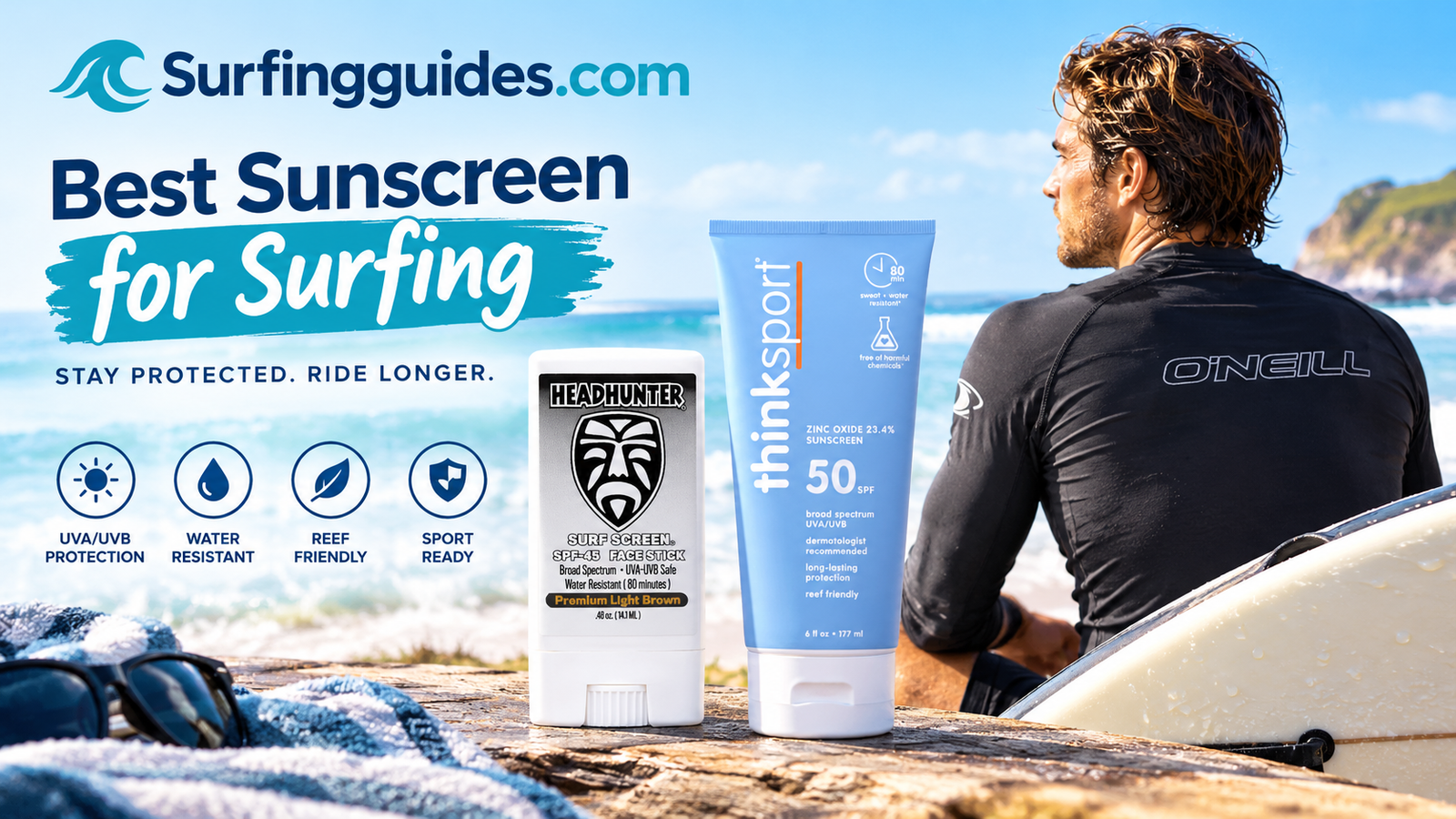
Ask a lineup of surfers what their most essential piece of equipment is and you’ll hear the usual answers: a good board, a well-fitting wetsuit, a reliable leash. But spend enough dawns in the water and you’ll notice the veterans quietly reach for one more thing before they paddle out — a sunscreen that actually works when it’s wet, salty, and getting shredded by reflection for three hours straight.
Regular beach sunscreen and surf sunscreen are not the same category of product, even though they share a shelf. A lotion that’s perfectly fine for a lazy afternoon on the sand can be gone from your face by the time you’ve finished your first paddle-out. Runny formulas sting eyes at the worst possible moment. Chemical filters can irritate skin that’s already been exfoliated by salt and sand. And some ingredients are increasingly unwelcome in the very breaks we love.
That’s why we put together this guide. We looked at the sunscreens that surfers, watermen, and ocean athletes actually keep in their board bags — face sticks loaded with zinc, mineral lotions for sensitive skin, sport formulas for marathon sessions, and a few premium options that feel invisible going on. Whether you’re planning your very first lesson (how long it takes to learn surfing is a common question) or you’ve been reading forecasts for years, this guide will help you pick the right protection for your next session.
How we picked: We focused on what matters in the water — staying power, eye comfort, skin feel, reapplication convenience, and environmental considerations. We deliberately avoided inventing hard specs, prices, or ratings. Where a formula’s exact composition is proprietary or varies by region, we describe how it behaves in real surf conditions instead of quoting numbers we can’t verify. If you’re brand new to the sport, our how to start surfing guide pairs well with this one.

Below you’ll find the full comparison table first, then twelve deep dives covering everything from ingredient science to application technique, followed by individual reviews of all fourteen picks. Let’s get into it.
Quick Comparison: Our Top Picks
Every sunscreen in this guide appears in the table below. Scroll sideways on a phone to see the full row — or tap any “Check Price” button to jump straight to the listing.
Swipe to see more →
| # | Image | Product & Best For | Key Specs | Verdict | Where to Buy |
|---|---|---|---|---|---|
| 1 |  |
Top PickHeadhunter Face Stick SPF 45Best Overall | SPF 45 Face stick format Targeted face, nose & ear coverage Stays put through wipeouts | The stick surfers keep in their board bag — quick swipes, zero eye sting. | Check Price on Amazon |
| 2 |  |
Sun Bum Mineral SPF 50 Face StickBest Mineral Face Stick | SPF 50 Mineral face stick Sensitive-skin friendly Pocketable reapplication | Mineral protection in a grab-and-go stick that’s gentle on faces. | Check Price on Amazon |
| 3 |  |
Blue Lizard Sensitive Mineral SPF 50+Best for Sensitive Skin | SPF 50+ Mineral formula Built for reactive skin Water-resistant wear | A gentle mineral option that doesn’t cut corners on protection. | Check Price on Amazon |
| 4 |  |
Waxhead Tinted Zinc Oxide SPF 30Best Tinted Face Option | SPF 30 Zinc oxide mineral Tinted to reduce white cast Face-friendly finish | Zinc coverage that actually blends in — great for faces and necks. | Check Price on Amazon |
| 5 | |
Thinksport Mineral SPF 50+Best Mineral Lotion | SPF 50+ Mineral lotion Sport-ready texture Reef-conscious formula | A mineral workhorse for active, all-day sessions outdoors. | Check Price on Amazon |
| 6 |  |
Thrive Natural Care Reef Safe SPF 50Best Reef-Conscious Pick | SPF 50 Reef-safe positioning Plant-forward formula Lotion format | For surfers who want their sunscreen to give back to the ocean. | Check Price on Amazon |
| 7 |  |
Freaks of Nature Peak Performance SPF 50Best for Performance Days | SPF 50 Performance lotion Sport-focused wear Built for long days outside | Amped-up protection for dawn patrol through last light. | Check Price on Amazon |
| 8 |  |
Shiseido Wetforce Ultimate Sun ProtectionBest Premium | Premium sun care line Wetforce wear technology Lightweight skin feel Water-ready performance | High-end sun care that feels as good as it protects. | Check Price on Amazon |
| 9 |  |
Aveeno Protect + Hydrate SPF 60Best Hydrating Lotion | SPF 60 Hydrating lotion Comfort-first skin feel Easy everyday layering | Comfort-first lotion that keeps skin happy through long sessions. | Check Price on Amazon |
| 10 |  |
Neutrogena Beach Defense SPF 70Best High SPF | SPF 70 High-SPF lotion Beach & surf ready Water-resistant wear | High SPF for surfers who burn fast and forget to reapply. | Check Price on Amazon |
| 11 |  |
Banana Boat Sport Ultra SPF 50Best Budget | SPF 50 Sport lotion Budget-friendly value Familiar sport performance | Dependable sport protection without the premium price. | Check Price on Amazon |
| 12 |  |
Coppertone Sport SPF 50Best Classic Sport | SPF 50 Sport lotion Sweat & water ready No-fuss application | A classic sport sunscreen that has stood the test of time. | Check Price on Amazon |
| 13 |  |
SLAM Men’s Sunscreen LotionBest for Men | Men’s lotion format Sport-ready wear Full-body coverage Sailing-inspired brand | Straightforward full-body coverage for guys who just want to paddle out. | Check Price on Amazon |
| 14 |  |
Project Reef Reef Safe SPF 50 LotionBest for Eco-Conscious Surfers | SPF 50 Reef-safe lotion Ocean-minded brand Full-body format | Solid surf-day protection with an eco conscience. | Check Price on Amazon |
Ready to gear up for your next session?
Browse today’s most popular surfing sunscreens and see current availability on Amazon.
Why Surfers Need Specialized Sunscreen (Not Just Any Bottle)
Surfing is one of the most demanding environments your skin will ever face, and it’s worth understanding why before you spend money on protection. Consider the conditions: you’re in and out of the water repeatedly, salt is drying and mildly abrasive, sand acts like fine-grit sandpaper on your legs and feet, and the sun is hitting you from two directions at once — directly from above and reflected upward off the water’s surface. On a bright day, that reflected exposure is meaningfully higher than standing on dry land, and it’s coming at angles most people never think about: under the chin, beneath the nose, the underside of the forearms, the fronts of the ears.
Then there’s time. A typical surf session runs one to three hours, and serious surfers often do two sessions in a day. Compare that with a beachgoer who applies sunscreen at 11 a.m. and sits under an umbrella. Surfers accumulate serious exposure, and they do it while their protection is being mechanically scrubbed off by paddling, duck diving, and repeated wipeouts.
Regular sunscreen is formulated for that beachgoer. It’s designed to feel light, absorb quickly, and smell pleasant. Those are fine goals, but they usually come at the cost of staying power. A thin, cosmetically elegant lotion may be eighty percent gone by the time you’ve caught your fifth wave. Surfers need formulas and formats that cling, stick, and refuse to run into the eyes — which is exactly why the products in this guide skew toward thicker mineral textures and solid sticks.
There’s also the eye-sting problem, and anyone who has experienced it knows it’s not a minor inconvenience. When sunscreen migrates into your eyes mid-session, your vision blurs, your eyes water, and you’re suddenly making decisions about waves and other surfers with compromised sight. That’s a genuine safety issue in a crowded lineup. It’s also why so many experienced surfers default to stick or paste formats for the face: they physically stay where you put them.
Finally, surfers tend to care about what they’re putting into the ocean. The reef-safe movement started with divers and surfers because we’re the ones literally immersed in the ecosystem we’re affecting. Choosing a sunscreen with that in mind isn’t just good ethics — in an increasing number of destinations, it’s the law.
Sun damage is cumulative, and surfing is a lifetime sport. The kid learning on a foam board and the veteran logging their four-thousandth session are both adding to the same ledger. Building a sunscreen habit early — as automatic as waxing up — is one of the highest-return things you can do for your long-term health. Training hard is part of the sport too; check out what muscles surfing works and how many calories surfing burns to understand why sessions are so depleting — and why you’re often too tired to remember reapplying.
Build your surf sun-protection kit
From face sticks to mineral lotions — see what’s available now.
Mineral vs. Chemical Sunscreen: Which Holds Up in the Water?
If there’s one debate that never ends in surf parking lots, it’s mineral versus chemical. The short answer is that both can protect you, but they work differently, feel different on the skin, and behave differently in the water. Let’s break it down without the marketing noise.
How mineral (physical) sunscreens work
Mineral sunscreens use zinc oxide, titanium dioxide, or both. Instead of being absorbed into the skin and neutralizing UV rays chemically, these mineral particles sit on the surface and act like a physical barrier — scattering and reflecting a portion of incoming UV, and converting the rest to heat at the skin’s surface. For surfers, the key advantages are:
- Immediate protection. Mineral formulas start working as soon as they’re on, with no waiting period before you paddle out.
- Eye comfort. Mineral sticks and pastes are far less likely to migrate and sting.
- Sensitive-skin friendliness. Zinc oxide in particular is well tolerated by skin that’s already irritated by salt, wind, and sand.
- Visible coverage. That famous white sheen is actually useful feedback — you can see exactly where you’ve applied and where you’ve missed.
The trade-offs: mineral formulas can feel thicker, may leave a white cast on deeper skin tones (tinted versions help), and can be slower to rub in. For full-body use, a good lotion and a bit of patience is all it takes.
How chemical sunscreens work
Chemical filters — ingredients like avobenzone, octocrylene, homosalate, and octisalate — absorb into the skin’s surface layer and dissipate UV radiation as heat. Their strengths are cosmetic elegance: they tend to rub in clear, feel lighter, and layer invisibly under other products. Many sport lotions that spread effortlessly across the whole body are chemical-based for exactly this reason.
The drawbacks for water sports are real, though. Chemical filters need about fifteen to twenty minutes to become effective, they can sting eyes more readily in a wet environment, and some people find them irritating on skin that’s been beaten up by salt water. There’s also the environmental question — a few common chemical filters have come under scrutiny for their effects on coral and marine life, which we cover in depth later in this guide.
So which should a surfer choose?
Here’s the practical framework we recommend:
- Face: Go mineral — ideally a stick or tinted zinc. The staying power and eye comfort are worth it.
- Body: Either works, but mineral is better if you have sensitive skin, and chemical is fine if you prioritize quick, even coverage and you’re disciplined about reapplying.
- Hybrid approach: Many surfers do exactly this — a zinc stick for the high-exposure zones (nose, cheeks, ears, neck, part line) and a sport lotion for the rest.
“Mineral sunscreen doesn’t work as well.” It does. The difference is cosmetic and behavioral, not protective. A mineral sunscreen applied thickly and reapplied consistently will outperform a “stronger” chemical lotion that’s applied thinly and forgotten. Technique beats ingredient marketing every single time.
Looking for mineral formulas?
See zinc oxide and mineral sunscreens available on Amazon.
How to Choose the Right Sunscreen for Surfing
Walking down the sunscreen aisle (or scrolling a product page) can be overwhelming. Strip away the packaging and the claims, and there are really only six things that matter for a surfer. Run every candidate through this checklist.
1. SPF level that matches your session
SPF measures protection against UVB rays — the ones that burn. As a general benchmark, SPF 30 blocks roughly 97% of UVB, while SPF 50 blocks around 98%. Higher numbers offer marginally more, but the gap between SPF 30 and SPF 70 is far smaller than the packaging suggests. What actually matters more is applying enough and reapplying. That said, surfers who are fair-skinned, surfing midday, or heading out for marathon sessions should lean toward the SPF 50 range or higher, simply as insurance against the inevitable lapses in reapplication.
2. Water resistance and staying power
Look for formulas that describe themselves as water resistant, and for surf specifically, favor thicker textures: sticks, pastes, and rich lotions over thin, fast-absorbing milks. The single best predictor of surf performance is how the product feels immediately after application. If it’s already slippery and invisible, it’s probably not going to survive a duck dive. If it feels like it’s clinging, it probably is.
3. Format: stick, lotion, or paste
- Face sticks are the surfer’s best friend — precise, mess-free, won’t run into eyes, and perfect for quick reapplications on the beach or even between sets.
- Lotions are the most economical way to cover large areas and the standard choice for the body.
- Zinc pastes and tinted mineral creams give maximum staying power for the face and nose, with tints that reduce the white cast.
4. Skin sensitivity
Salt water, wind, and sand compromise your skin barrier before you even apply anything. If your skin is reactive, choose mineral formulas marketed for sensitive skin, skip heavy fragrance, and patch-test new products on a calm day rather than discovering a reaction on a surf trip. Gentle options like the ones in our mineral section are a smart default.
5. Reef and environmental considerations
If you surf in coral-adjacent areas — Hawaii, the tropics, parts of Central America and Southeast Asia — check local regulations and consider mineral or reef-conscious formulas. We cover this in detail later in the guide.
6. Practicality in the real world
Think about how you’ll actually use it. A sunscreen that lives in your board bag, car, or backpack and gets applied consistently beats a “better” sunscreen left at home. Convenience features matter: stick formats that work with sandy hands, tubes that don’t leak when crushed, and sizes that fit in a wetsuit pocket or a beach tote. The same practicality principle applies to the rest of your kit — see our guide to what you need for surfing for the full checklist.
If buying two products feels like overkill, consider it a lifetime investment: one face stick for high-exposure zones and one body lotion for everything else. This combo covers every scenario — dawn patrol, long travel days, quick lunch-break surfs — for years.
Compare face sticks and lotions side by side
See current options for water-resistant sunscreen built for sports.
Best Face Sticks for Surfing
Ask a hundred surfers what they put on their face and a surprising number will pull a stick out of their wetsuit pocket, glove box, or board bag. Face sticks have earned their cult following for good reason: they go on thick, stay exactly where you swipe them, don’t drip into your eyes, and can be reapplied with sandy hands in under thirty seconds. For the highest-burn zones — nose, cheekbones, ears, lips’ edges, and the part line — nothing else comes close.
This category is dominated by two picks, with a tinted mineral option rounding out the face-focused trio. Here’s how they compare before we dig into each one.
Swipe to see more →
| # | Image | Product | Key Specs | Where to Buy |
|---|---|---|---|---|
| 1 | |
Headhunter Face Stick SPF 45Best Overall | SPF 45Thick stick textureLineup-friendly | Check Price on Amazon |
| 2 | |
Sun Bum Mineral SPF 50 Face StickBest Mineral Stick | SPF 50Mineral-basedSensitive-skin friendly | Check Price on Amazon |
| 3 | |
Waxhead Tinted Zinc Oxide SPF 30Best Tinted | SPF 30Tinted zinc oxideBlends on skin | Check Price on Amazon |
Headhunter Face Stick SPF 45
The stick that lives in every surfer’s board bag.
Headhunter has built an almost word-of-mouth reputation among watermen, and this face stick is the reason. It’s a thick, no-nonsense sunscreen stick designed specifically for the parts of your face that take the most abuse during a session: nose, cheeks, ears, and the back of the neck. You swipe it on and it stays — through paddling, duck dives, and the inevitable hold-down — without creeping into your eyes and blurring your vision at the worst moment.
What makes it special is the texture. It’s dense enough to lay down a visible protective layer, which means you can actually see your coverage before you paddle out. That visual feedback matters more than people realize: most sunburn happens where coverage was missed, not where protection failed. With a stick this consistent, you know exactly what’s covered.
Key Features
- SPF 45 protection targeted at the face and ears — the zones that burn fastest on the water.
- Stick format that applies cleanly with sandy or wet hands, no rubbing required.
- Stays where you put it — thick texture that resists running into the eyes during long sessions.
- Lineup-friendly reapplication — quick to top up on the beach between sessions without a full redo.
- Compact and packable — fits easily into a board bag, backpack, or wetsuit pocket.
Pros
- Exceptional staying power on the face
- Won’t sting eyes mid-session
- Fast, mess-free application
- Visible coverage you can check
- Trusted by serious watermen
Cons
- Not practical for full-body use
- Stick size means frequent replacement for daily surfers
- Thick finish is intentional, not invisible
Sun Bum Mineral SPF 50 Face Stick
Mineral protection, stick convenience.
Sun Bum’s mineral face stick brings the appeal of a mineral formula — gentle, sensitive-skin friendly, immediate protection — into the format surfers love most. It’s a natural fit for anyone who has had bad luck with lotions that sting after a few hours of saltwater exposure, or for surfers who prefer to keep their face routine simple and mineral-only.
The stick design is compact enough to live in a jacket pocket or the front pouch of a backpack, which makes reapplication genuinely easy. That’s the hidden superpower of this category: the best sunscreen is the one you’ll actually reapply, and a stick removes every excuse. No mess, no lotion-covered hands fumbling with zippers — just a quick swipe and back to the water.
Key Features
- SPF 50 mineral protection in a convenient stick format for faces and ears.
- Gentle on reactive skin — a smart choice if salt water leaves your face tight or irritated.
- Swipe-on application that works even when your hands are sandy and wet.
- Travel-friendly size that fits anywhere from a wetsuit pocket to a carry-on.
- Immediate protection — no waiting around before you paddle out.
Pros
- Mineral formula suits sensitive skin
- Extremely convenient to reapply
- Higher SPF rating for a face stick
- Great for travel and quick sessions
Cons
- Mineral sticks can leave a light cast on deeper skin tones
- Best used on face and neck rather than the whole body
- Small format runs out faster for daily surfers
Waxhead Tinted Zinc Oxide SPF 30
Zinc that blends in instead of standing out.
The classic surfer’s complaint about zinc is the white cast — that unmistakable stripe across the nose that signals “serious waterman” to everyone on the beach. Waxhead’s tinted zinc oxide solves the vanity problem without giving up the performance. It’s a mineral sunscreen with a tint that helps it melt into the skin, making it a realistic everyday option for your face and neck, not just a competition-day war paint.
Zinc oxide is the gold standard for surfers because it’s photostable, gentle, and physically sits on the skin where it belongs during a session. Waxhead leans into a simple, ingredient-conscious philosophy, which appeals to surfers who read labels carefully and prefer straightforward formulations over long ingredient decks full of things they can’t pronounce.
Key Features
- Tinted zinc oxide formula that reduces the white cast traditional zinc leaves behind.
- SPF 30 mineral protection from a trusted physical filter.
- Face-friendly finish — works well on noses, cheeks, and necks without feeling heavy.
- Simple ingredient philosophy aimed at people who care what goes on their skin.
- Great for layering under or over other face products before a session.
Pros
- Tint blends into skin naturally
- Zinc oxide is a proven surf-friendly filter
- Comfortable for daily face use
- Appeals to ingredient-conscious surfers
Cons
- SPF 30 means disciplined reapplication on long days
- Single tint may not match every skin tone
- Better suited to face and neck than full body
Want more face-stick options?
See more zinc and mineral face sticks made for outdoor sports.
Best Mineral Sunscreens for Surfers
Mineral sunscreens are the default recommendation for anyone spending serious time in the water, and this group represents the cream of the crop. Whether your priority is sensitive skin, reef considerations, or simply the reliable, sits-on-top protection that zinc and titanium dioxide deliver, these four products deserve a place in the conversation. We’ve already covered Waxhead’s tinted zinc in the face section — it belongs here too as a face-focused mineral pick — alongside three outstanding mineral lotions.
Swipe to see more →
| # | Image | Product | Key Specs | Where to Buy |
|---|---|---|---|---|
| 1 | |
Blue Lizard Sensitive Mineral SPF 50+Best for Sensitive Skin | SPF 50+MineralSensitive-skin focus | Check Price on Amazon |
| 2 | |
Thinksport Mineral SPF 50+Best Mineral Lotion | SPF 50+Mineral lotionSport-ready | Check Price on Amazon |
| 3 | |
Thrive Natural Care Reef Safe SPF 50Best Reef-Conscious | SPF 50Reef-safe positioningPlant-forward | Check Price on Amazon |
| 4 | |
Waxhead Tinted Zinc Oxide SPF 30Best Tinted Zinc | SPF 30Tinted zinc oxideFace-friendly | Check Price on Amazon |
Blue Lizard Sensitive Mineral SPF 50+
The gentle mineral that takes protection seriously.
Blue Lizard has earned its loyal following the honest way — by making mineral sunscreens that people with reactive skin can actually use every day. The Sensitive variant is built around exactly the use case surfers face: skin that’s been exposed to salt, wind, and sand and needs something protective without being aggressive. If you’ve ever applied a sunscreen after a long session and felt the sting, this is the kind of formula that fixes that problem.
As a mineral sunscreen, it starts working the moment it’s on and doesn’t rely on chemical filters that some users prefer to avoid. The brand is widely recognized for its sun-conscious design details, and its reputation among families and outdoor enthusiasts speaks for itself. For surfers with fair or easily burned skin, a mineral lotion at SPF 50+ applied properly is genuinely hard to beat.
Key Features
- Mineral formula designed with sensitive, reactive skin in mind.
- SPF 50+ protection for high-exposure days on the water.
- Water-resistant wear suited to active, in-and-out-of-the-water use.
- Gentle everyday feel that works for face and body alike.
- Trusted brand reputation among families and outdoor athletes.
Pros
- Excellent choice for sensitive skin
- High SPF with mineral filters
- Works for both face and body
- Widely trusted, easy to find
Cons
- Mineral lotions need a few minutes to settle
- Can leave a light white cast before fully worked in
- Tube format is less convenient mid-session than a stick
Thinksport Mineral SPF 50+
The mineral workhorse for athletes and ocean people.
Thinksport built its reputation in the world of endurance sports and outdoor adventure, and that heritage shows in how this sunscreen behaves. It’s a mineral lotion with a sport-ready texture — substantial enough to hold up during sweaty, splashy, high-output activity, but smooth enough to spread across the whole body without a wrestling match.
For surfers, the appeal is straightforward: you get mineral protection at a high SPF from a brand that takes ingredient standards seriously. It’s the kind of sunscreen that lives in the beach bag all season and gets used for everything — surfing, paddling, coastal runs, and long days in the boat. If you want one mineral lotion that handles the entire family’s outdoor life, this is an easy recommendation.
Key Features
- SPF 50+ mineral protection using physical filters for immediate coverage.
- Sport-ready texture designed for active outdoor use, including water sports.
- Reef-conscious formulation aligned with what water athletes look for.
- Full-body usability — one bottle for face, body, and everything in between.
- Performance-minded brand with a strong following among outdoor athletes.
Pros
- High-SPF mineral protection
- Great texture for full-body application
- Popular with outdoor athletes
- Good everyday surf-bag staple
Cons
- Like all mineral lotions, takes a moment to rub in
- May feel substantial in hot conditions
- Still needs reapplication during marathon sessions
Thrive Natural Care Reef Safe SPF 50
Protection that gives something back to the ocean.
Thrive takes the reef-safe idea further than a label claim. The brand positions itself around plant-forward sourcing and ocean-conscious formulation — the kind of mission-driven approach that resonates with surfers who spend their lives in the water and want their gear purchases to reflect that. But mission alone doesn’t survive a duck dive, so it helps that the sunscreen itself performs: SPF 50, lotion format, and built to be worn during serious outdoor activity.
What we appreciate is the alignment of values and use case. This is a sunscreen made for people who are in and around the ocean, by a company that talks about regenerative sourcing and community impact in the regions where its ingredients come from. If you want your sunscreen dollar to mean something beyond a bottle, this is the one to look at.
Key Features
- Reef-safe positioning — formulated with coral and marine ecosystems in mind.
- SPF 50 protection in an easy-spreading lotion format.
- Plant-forward ingredient approach sourced with sustainability goals.
- Mission-driven brand focused on giving back to sourcing communities.
- Everyday versatility for face and body before surf, paddle, or beach days.
Pros
- Strong environmental credentials
- Solid SPF 50 protection
- Feels good on skin during activity
- Great story and brand mission
Cons
- Less widely stocked than mainstream brands
- Lotion format needs a stick companion for in-water touch-ups
- Premium positioning
Shop mineral sunscreens
Compare more zinc oxide and mineral options on Amazon.
Best Sport Lotions for Long Sessions
Sometimes you need to cover a lot of skin quickly, evenly, and affordably — and that’s where sport lotions earn their place. These are the full-body workhorses: easy to spread, quick to cover arms, legs, back, and neck, and formulated to handle sweat, spray, and splashing. Every product in this group is designed for exactly the kind of prolonged outdoor activity that surf sessions represent, and each brings a slightly different personality to the table.
Swipe to see more →
| # | Image | Product | Key Specs | Where to Buy |
|---|---|---|---|---|
| 1 | |
Aveeno Protect + Hydrate SPF 60Best Hydrating | SPF 60Hydrating lotionComfort-first feel | Check Price on Amazon |
| 2 | |
Neutrogena Beach Defense SPF 70Best High SPF | SPF 70High-SPF lotionWater resistant | Check Price on Amazon |
| 3 | |
Banana Boat Sport Ultra SPF 50Best Budget | SPF 50Sport lotionGreat value | Check Price on Amazon |
| 4 | |
Coppertone Sport SPF 50Best Classic | SPF 50Sport lotionSweat & water ready | Check Price on Amazon |
Aveeno Protect + Hydrate SPF 60
Sun protection that doubles as skin care.
Surfing is brutal on skin, and Aveeno’s Protect + Hydrate line takes the counterintuitive approach of actually nourishing it while protecting it. If your post-session skin feels tight, dry, and generally abused — a common complaint among people who surf daily — a hydrating sunscreen formula is a genuinely thoughtful choice. You get high SPF protection alongside the comfortable, conditioned feel Aveeno is known for.
The SPF 60 rating provides real margin for long, bright sessions, and the lotion format spreads quickly across the whole body. It’s not trying to be a hardcore performance product with a laundry list of buzzwords; it’s a smart, comfortable daily driver for surfers who want to protect their skin without feeling like they’re wearing armor.
Key Features
- SPF 60 protection for extended sun exposure during long sessions.
- Hydrating lotion feel that helps skin stay comfortable in harsh conditions.
- Quick-spreading formula for full-body application before paddling out.
- Comfort-first wear — layers well without feeling heavy or greasy.
- Everyday versatility for surf days, travel days, and everything between.
Pros
- Hydrating feel suits salt-dried skin
- High SPF for long sessions
- Easy, even full-body application
- Great daily-use comfort
Cons
- Lotion format needs reapplication discipline
- Not a face-stick substitute for in-water touch-ups
- Comfort-first texture may feel less “locked in” than zinc
Neutrogena Beach Defense SPF 70
Maximum SPF for the forgetful reapplicers.
Let’s be honest about human behavior: plenty of surfers say they’ll reapply and then don’t. If that sounds like you, the smartest strategy is to start with as much protection as possible — and that’s the argument for a high-SPF lotion like Beach Defense SPF 70. It’s built for exactly the environment we’re talking about: beach and water, big exposure, long days, and imperfect habits.
The lotion format covers large areas quickly, and the water-resistant character of the formula means it’s designed to cope with splashing and immersion better than a standard everyday sunscreen. Neutrogena’s sun care range is one of the most widely available out there, which means you can actually restock on a trip without hunting through specialty stores.
Key Features
- SPF 70 protection — among the highest ratings you’ll find in a sport lotion.
- Beach-ready formula designed for water environments and high reflection.
- Water-resistant wear for active use in and out of the surf.
- Fast full-body coverage in a familiar, easy-spreading lotion.
- Widely available for easy restocking on surf trips.
Pros
- Very high SPF rating
- Designed for beach and water use
- Easy to find and restock
- Good for fair skin and long exposure
Cons
- High SPF doesn’t replace reapplication
- Chemical-leaning formulas can sting eyes
- Best paired with a mineral stick for the face
Banana Boat Sport Ultra SPF 50
The budget pick that shows up every time.
There’s a lot to be said for a sunscreen that’s affordable enough to use generously — because the number-one application mistake surfers make is using too little. A value-friendly sport lotion removes the temptation to ration, and Banana Boat’s Sport Ultra line has been a fixture in beach bags for years precisely because it delivers reliable performance at a price that doesn’t sting.
SPF 50 is the sweet spot for sport use, and the sport-formulated texture is designed to cope with sweat and water. It’s not glamorous, it won’t win any packaging design awards, and it doesn’t need to. It’s the sunscreen you slather on before a dawn patrol and again before the afternoon session without thinking twice about cost.
Key Features
- SPF 50 sport protection — the benchmark rating for active outdoor use.
- Sport-formulated wear designed to handle sweat and water exposure.
- Excellent value that encourages generous, correct application.
- Fast full-body coverage in a classic lotion texture.
- Easy to find nearly anywhere sunscreen is sold.
Pros
- Very affordable for daily use
- Sport-ready SPF 50 formula
- Encourages proper, generous application
- Great for group and family use
Cons
- Basic, no-frills experience
- Not positioned as reef-safe
- Lotion needs reapplication like any lotion
Coppertone Sport SPF 50
A classic that has earned its shelf space.
Some products have been around long enough that they simply are the category, and Coppertone’s Sport line is close to that status in the sunscreen world. Generations of athletes have grown up with it, and there’s a reason it keeps getting repurchased: it works, it’s easy to apply, and it’s formulated for exactly the kind of vigorous, sweaty, splashy activity that a surf session represents.
The sport formula is built to stay put during movement, which makes it a sensible body option before long sessions. It spreads evenly, absorbs reasonably quickly for a sport lotion, and doesn’t require a chemistry degree to understand. For surfers who want a set-it-and-forget-it body sunscreen from a brand they already trust, this is a dependable pick.
Key Features
- SPF 50 sport protection for high-output outdoor activity.
- Sweat and water-ready wear formulated for movement.
- Easy, no-fuss application across the whole body.
- Long-standing brand trust built over decades of sport use.
- Widely stocked for simple restocking at any drugstore or shop.
Pros
- Reliable, proven sport performance
- Easy to apply and spread evenly
- Great availability everywhere
- Straightforward product, no gimmicks
Cons
- Mainstream formula isn’t marketed as reef-safe
- Standard lotion format for the body, not the face
- Needs reapplication on long water days
Compare sport sunscreens
See more lotions formulated for outdoor sports and water activity.
Performance & Premium Picks for Serious Surfers
This group is for surfers who want more from their sunscreen than basic coverage — whether that’s performance-driven formulation, luxury skin feel, a specific brand identity, or a strong environmental mission. These four products each bring something distinctive to the table, and each has its own devoted following among people who spend serious time in the sun and salt.
Swipe to see more →
| # | Image | Product | Key Specs | Where to Buy |
|---|---|---|---|---|
| 1 | |
Freaks of Nature Peak Performance SPF 50Best Performance | SPF 50Performance lotionLong-day wear | Check Price on Amazon |
| 2 | |
Shiseido Wetforce Ultimate Sun ProtectionBest Premium | Premium formulaWetforce wearLightweight feel | Check Price on Amazon |
| 3 | |
SLAM Men’s Sunscreen LotionBest for Men | Men’s lotionSport-readyFull-body | Check Price on Amazon |
| 4 | |
Project Reef Reef Safe SPF 50 LotionBest Eco Pick | SPF 50Reef-safe lotionOcean mission | Check Price on Amazon |
Freaks of Nature Peak Performance SPF 50
Built for athletes who treat the outdoors like a second home.
Freaks of Nature approaches sunscreen as performance gear rather than a toiletry, and that mindset shows throughout the Peak Performance formula. This is a sunscreen for people with active, outdoor lives — surfers, trail runners, climbers, sailors — who need their sun protection to keep pace with long, physically demanding days rather than a leisurely hour by the pool.
The brand’s angle blends performance with a more conscious ingredient approach, which makes it appealing to the growing number of athletes who want both effectiveness and cleaner formulations. SPF 50 is the right target for sport use, and the lotion format makes sense for full-body application before everything from dawn patrol to all-day mountain missions.
Key Features
- SPF 50 performance protection aimed at athletes and outdoor enthusiasts.
- Sport-focused wear designed for long, high-output days outside.
- Performance-first formulation that treats sunscreen as essential gear.
- Full-body lotion format for comprehensive coverage before any activity.
- Conscious ingredient approach for label-aware consumers.
Pros
- Designed for real athletic use
- Balances performance and cleaner ingredients
- Great for multi-sport outdoor lives
- Strong brand ethos
Cons
- Less mainstream availability
- Premium positioning vs. drugstore lotions
- Still needs the usual reapplication routine
Shiseido Wetforce Ultimate Sun Protection
Luxury sun care that behaves beautifully in the water.
Shiseido comes from the world of high-end skin care, and their Ultimate Sun Protection line — famously built around their Wetforce wear philosophy — is the sunscreen equivalent of a well-engineered wetsuit. It feels refined going on, wears lightly, and is designed with water exposure in mind, which makes it a genuinely interesting option for surfers who are willing to pay more for a product that feels invisible while performing.
The cosmetic elegance here is the differentiator. Many high-protection sunscreens feel like a chore to apply; this one feels like a premium skin product. For surfers who also care about their skin beyond the water — and who want sunscreen they’ll happily wear every single day, not just on surf days — that daily-wear appeal is worth a lot. Consistency is everything in sun protection.
Key Features
- Wetforce wear philosophy — the line is engineered around staying effective around water.
- Lightweight, refined skin feel from a premium sun care leader.
- Water-ready performance for active use in wet environments.
- Everyday-wear elegance that encourages consistent daily application.
- Ultimate Sun Protection heritage from a globally respected brand.
Pros
- Exceptional skin feel and finish
- Designed with water exposure in mind
- Feels great for daily wear
- Premium, well-engineered formula
Cons
- Premium price point
- Not the pick for budget-conscious surfers
- Refined texture is less “locked-in” than heavy zinc
SLAM Men’s Sunscreen Lotion
No-frills coverage from a brand that lives on the water.
SLAM comes out of the sailing world — a sport defined by glare, spray, and relentless sun exposure — and that DNA carries straight into their men’s sunscreen lotion. This is a straightforward product for guys who want to slap on coverage before heading out and not think about skincare routines, textures, or fragrances. It’s full-body protection designed for real-world use on real-world water.
If your sunscreen buying criteria is “does it work, is it easy, and will it survive a session,” this delivers without ceremony. The lotion format covers everything quickly, and the sport orientation means it’s formulated with activity in mind rather than poolside lounging.
Key Features
- Men’s lotion format with a straightforward, no-fuss application feel.
- Sport-ready wear informed by sailing and water-sport demands.
- Full-body coverage for arms, legs, back, neck, and shoulders.
- Water-sport heritage from a brand built around life on the water.
- Simple daily driver for surfers who want to get on with it.
Pros
- Easy, no-nonsense full-body application
- Designed with water sports in mind
- Great “just works” option
- Appeals to sunscreen minimalists
Cons
- Less widely known than mainstream brands
- Lotion format, so pair with a face stick for sessions
- Fragrance preferences may vary
Project Reef Reef Safe SPF 50 Lotion
Surf protection with an ocean-first mission.
Project Reef puts the ocean at the center of its identity, and that focus resonates strongly with surfers — we’re the community most directly connected to the marine environments that sunscreen choices affect. The Reef Safe SPF 50 lotion delivers the practical goods alongside that mission: solid SPF 50 protection, a lotion format for full-body use, and a formula positioned with reef health in mind.
What makes it stand out is the brand’s whole approach: this isn’t a mainstream company bolting on an eco label, but a brand organized around ocean-minded values. For surfers who want their purchases to support that direction while still getting real, session-ready protection, Project Reef is a compelling choice — especially for tropical surf trips where reef-safe options genuinely matter.
Key Features
- SPF 50 reef-safe lotion designed with marine environments in mind.
- Ocean-minded brand mission centered on reef and coastal health.
- Full-body lotion format for complete coverage before sessions.
- Tropical-trip friendly — a smart choice where reef rules apply.
- Mission-aligned purchase for surfers who vote with their wallet.
Pros
- Reef-conscious formulation
- Strong, authentic ocean mission
- Solid SPF 50 everyday protection
- Great fit for tropical surf travel
Cons
- Niche availability compared to big brands
- Lotion rather than stick for in-water touch-ups
- Reef-safe claims still deserve label-checking
Explore performance sunscreens
See more premium and performance formulas built for outdoor sport.
Reef Safety and Ocean-Friendly Sunscreen Choices
The reef-safe conversation matters to surfers more than almost any other outdoor community, and it’s worth understanding the substance behind the marketing. Coral reefs around the world are under pressure from warming waters, pollution, and coastal development. Sunscreen chemicals are not the biggest factor in that story, but they are one of the few contributors that individual water users can control instantly and completely.
The ingredients under scrutiny
The two chemical filters that have drawn the most attention are oxybenzone and octinoxate. Research has raised concerns about their effects on coral larvae and reef ecosystems at concentrations found in heavily visited bays and lagoons — exactly the kinds of places surfers paddle out. As a result, a growing list of destinations has moved to restrict sunscreens containing these ingredients, with Hawaii being the most prominent example. Parts of Mexico, the U.S. Virgin Islands, Key West, and several island nations have introduced similar measures or guidelines.
This doesn’t mean chemical sunscreen is evil or that you should skip protection entirely — a sunburned surfer helps nobody, least of all themselves. It means that if you’re surfing in sensitive reef environments, choosing a mineral or reef-conscious formula is a sensible, low-effort way to reduce your footprint.
What “reef safe” actually means
Here’s the honest truth: “reef safe” is not a regulated term in most markets. Any brand can print it on a bottle. That means it’s a signal of intent, not a guarantee. To make a genuinely informed choice, check the ingredient list yourself:
- Look for mineral filters — zinc oxide and titanium dioxide are the most commonly accepted options in restricted zones.
- Avoid oxybenzone and octinoxate when heading to regulated or reef-adjacent destinations.
- Consider non-nano formulations if you want to go further on particle-size questions.
- Skip spray sunscreens near the water — a large portion of the product ends up on the sand and in the sea rather than on your skin.
Practical reef-friendly surfing habits
Ingredients are only half the equation. How you use sunscreen matters just as much. Apply only what you need — the “shot glass” amount for the body is a useful guideline, and there’s no benefit to slathering on five times more than your skin can absorb. Put sunscreen on before you leave the house or the car, not while standing ankle-deep in the shallows where half of it washes off into the water. And lean on physical barriers — rash guards, wetsuits, hats — to reduce the total amount of chemical load entering the ocean.
Before any surf trip, spend two minutes checking local sunscreen regulations. Bringing a restricted sunscreen to a regulated island can mean confiscation at customs — and scrambling to find an approved alternative on arrival. Pack mineral or reef-conscious formulas and you’ll never have to think about it.
Shopping for reef-conscious sunscreen?
Browse mineral and reef-safe formulas on Amazon before your next trip.
How to Apply Sunscreen Before and During a Surf Session
The best sunscreen in the world fails if it’s applied badly, and application is where most surfers lose the plot. This is the unglamorous chapter that will do more for your skin than any product upgrade. Follow this routine and you’ll be protected through sessions that leave everyone else pink.
Before you leave the house
Apply your base layer of body sunscreen at least fifteen to twenty minutes before paddling out. Doing it at home — not at the beach — accomplishes several things: it gives the formula time to bond with your skin, it ensures you actually cover everything (bathroom mirrors beat car mirrors), and it prevents the wasteful “apply in the shallows” habit that pollutes the lineup. Cover the easy-to-miss zones: tops of feet, backs of knees, ears, the back of the neck, and hands.
The face routine
For the face, use a stick or tinted zinc and apply generously: across the nose, over both cheekbones, along the ears (front and back), across the forehead, and down the neck to wherever your wetsuit or rash guard begins. Don’t forget the lips — a lip balm with sun protection is a tiny purchase that prevents a world of pain. If you part your hair, run the stick along the part line; scalp burns are miserable and incredibly common among surfers.
Layering with a wetsuit or rash guard
Apply sunscreen to exposed skin and around the edges of your suit — collarbone, wrists, ankles, and face — and consider a rash guard for the rest. The less sunscreen you need overall, the longer it lasts and the less ends up in the water. If you’re new to surf gear, our guides to the best rash guards for surfing and the best wetsuits for surfing cover the physical protection side in depth.
During the session
Reapply every two hours at minimum — and more often if you’re in the water the whole time. The practical surf version of this rule: reapply between sessions, and keep a face stick in your board bag for quick top-ups. If your session is a marathon one (three hours-plus, or multiple surfs per day), plan a full reapplication break. Yes, it means getting out of the water. The alternative is the lobster walk of shame through the parking lot.
After the session
Rinse with fresh water when you can, then moisturize. Salt and sun together are dehydrating, and skin that’s well-cared-for recovers faster and takes sunscreen better next time. If you’ve had a heavy-zinc session, an oil-based cleanser removes stubborn residue without scrubbing raw skin.
Keep a face stick clipped inside your board bag’s mesh pocket so it’s the last thing you see before paddling out. If you make application part of the wax-up ritual, you’ll never skip it. While you’re at it, work on your wave technique — see how to paddle out surfing for smoother entries to your sessions.
Get the right application tools
See face sticks and sport sunscreens that make reapplication easy.
Beyond Sunscreen: Rash Guards, Wetsuits, and Physical Sun Protection
Here’s a truth that sunscreen companies don’t advertise: the most effective sun protection is the kind you wear. Physical barriers block UV completely, never wash off, don’t need reapplying, and don’t add anything to the ocean. Sunscreen is the necessary supplement — but gear is the foundation. Building a smart sun-protection system means looking at your whole quiver.
Rash guards: the first line of defense
A good surf rash guard covers your entire torso and shoulders — the areas that take the most direct overhead exposure during paddling. Look for a close, athletic fit (loose fabric chafes and floats), flatlock or welded seams, and a high UPF rating. Long-sleeve versions extend protection down the arms, which matters enormously on long sessions. They also double as wetsuit liners and travel shirts. We’ve reviewed the standouts in our best rash guards for surfing guide.
Wetsuits: full-body armor
A wetsuit is, functionally, the highest-UPF garment you’ll ever own. Everything it covers is completely protected — which is why so many surfers only ever burn on their faces, necks, and hands. If you’re choosing a suit, fit and warmth come first, but consider coverage: full suits are the ultimate sun option, and springsuits and long-sleeve tops sit in the middle. Our main best wetsuits guide covers the field, and cold-water surfers should look at the best cold water wetsuits specifically. Wondering what goes underneath? Here’s what to wear under a wetsuit, and if you’re building a full wardrobe from scratch, our what to wear surfing guide walks through every layer.
Booties, hoods, and gloves
In cold water, exposed extremities take a beating from both temperature and sun. Surfing booties protect feet from reef, rock, and UV alike, and hoods protect one of the most commonly burned zones on any surfer — the scalp and ears. These pieces earn their keep beyond warmth.
Hats and eye protection
A surf hat with a chin strap or a wide-brimmed cap designed for water use makes an enormous difference on long, slow days — think longboard sessions, boat trips, and flat-water paddles. For eyes, consider dedicated surf sunglasses with retention straps. Cumulative UV exposure contributes to eye damage over a lifetime, and glare off the water is intense. It’s one of those protections you don’t appreciate until you need it.
The system approach
Here’s how experienced surfers combine everything: rash guard or wetsuit for the torso and limbs, hat for long sessions, and sunscreen only where skin is genuinely exposed — face, neck, ears, hands. That approach minimizes sunscreen use, maximizes protection, and lasts all day without a single reapplication break.
Round out your sun-protection kit
See UPF rash guards and surf sun gear on Amazon.
Storage, Shelf Life, and Making Your Sunscreen Last
Sunscreen is one of those products people treat as permanent — a tube rolls around in the car for years and gets used with full confidence. That’s a mistake, and it’s one that quietly undermines everything else in this guide. Here’s how to keep your protection actually protective.
Heat is the enemy
The worst place for sunscreen is exactly where surfers put it: the car. On a summer day, a dashboard or glove box can reach temperatures that degrade active ingredients and break down emulsions. The result is a product that looks the same but protects less. Store sunscreen in a cool, dry place — a closet, a shaded bag, an inside pocket — and if it must live in your board bag, keep the bag out of direct sun between sessions.
Shelf life and expiration
Most sunscreens carry an expiration date, and formulas generally remain fully effective for up to three years from manufacture when stored properly. If there’s no date visible, treat the purchase date as your benchmark. Beyond expiration, the protective ingredients lose potency and the texture may separate. Signs your sunscreen has gone off: unusual smell, watery or clumpy consistency, or a color shift. When in doubt, replace it — sunscreen is inexpensive compared to what it prevents.
Handling mineral formulas
Mineral sunscreens can separate more noticeably than chemical ones, since the active particles are suspended in the base. Shake the bottle before use and squeeze tubes from the bottom. If a mineral lotion has been sitting in the cold, warm it in your hands before applying — it spreads far more evenly at skin temperature.
Maximizing every application
- Apply to clean, dry skin when possible. Sunscreen adheres better to skin that isn’t already coated in salt residue or a thick layer of moisturizer.
- Use enough, but not too much. The guideline of roughly a shot glass of lotion for the body is a good starting point; adjust up for larger frames and long limbs.
- Reapply, don’t pile on. A fresh layer every couple of hours beats one enormous initial application that never absorbs.
- Keep one sunscreen everywhere. Board bag, car, bathroom, backpack. The best system is the one that removes friction.
Make it part of the routine
The surfers who never burn are not genetically lucky — they’re systematic. Sunscreen goes on with the same ritual as waxing the board and checking the fins. It takes two minutes, and it’s the highest-return two minutes of the entire session. If you’re still assembling the rest of your gear, our what do you need for surfing checklist is the natural next read.
Restock your sun protection
See mineral sunscreens and face sticks to keep in every bag.
Common Sun Protection Mistakes Surfers Make
After talking to countless surfers about their routines, the same mistakes come up again and again. The good news: every one of them is easy to fix, and fixing them will change your relationship with long sessions more than any new board will.
1. Using way too little
This is the big one. Most people apply roughly half of the recommended amount of sunscreen, which means their SPF 50 is functioning more like SPF 25. Be generous with the body lotion and unapologetically thick with face zinc. You cannot over-apply sunscreen in a meaningful way — the only real limit is how much your skin can absorb.
2. Skipping the reapplication
Two hours is the guideline, and in the water it’s even shorter. If you’re surfing a long session or doing a double, reapplication is non-negotiable. Keep a stick in your board bag and a lotion in the car, and treat the between-sessions break as non-negotiable sun time.
3. Forgetting the map-of-the-face spots
Ears (front and back), the side of the neck, the part line, the tops of the feet, the backs of the hands, and the nose. These are where burns happen, session after session. A face stick makes covering them effortless.
4. Trusting cloudy days
UV penetrates cloud cover easily, and reflection off the water remains intense on overcast days. Some of the worst surf sunburns happen under gray skies precisely because nobody bothers to apply. Overcast sessions still demand full protection.
5. Relying on sunscreen alone
As covered earlier, physical barriers are more reliable than any lotion. Rash guards, wetsuits, and hats don’t wash off. Surfers who wear them and top up the exposed skin get better protection with less effort.
6. Eye neglect
Between surface glare and reflected light from below, your eyes take serious UV load during sessions. Over a lifetime of surfing, that exposure adds up. Consider surf-rated eyewear for long flat days and general eye care for the long run. And note that sun exposure isn’t the only risk out there — if you’re weighing the sport’s hazards generally, our look at is surfing dangerous covers what to watch for.
7. Using old or heat-damaged product
The three-year-old tube in your board bag is not doing what you think it’s doing. Check dates, store cool, and replace anything that’s changed in texture or smell.
8. Applying for the first time in the parking lot
Sunscreen needs time to set. Fifteen to twenty minutes before exposure is the standard recommendation. Make it part of your pre-surf ritual at home, and you’ll never scramble in a sandy parking lot again.
Almost every mistake on this list disappears with one habit: a two-product system — face stick plus body lotion — stored in the same place as your wax. That’s it. That’s the entire upgrade.
Fix your routine with the right products
Find a face stick and body lotion combo that works for your sessions.
Frequently Asked Questions
What SPF should surfers actually use?
For most surfers, SPF 30 is the minimum worth considering and SPF 50 is the practical sweet spot. SPF 30 blocks roughly 97% of UVB rays and SPF 50 blocks around 98%, so the jump between them is smaller than the packaging implies — what matters far more is applying enough product and reapplying regularly. If you’re fair-skinned, surfing in tropical sun, or prone to burning, going higher gives you useful margin. But a well-applied SPF 50 beats a carelessly applied SPF 100 every time.
Is mineral or chemical sunscreen better for surfing?
Mineral formulas have the edge for surfing specifically. Zinc oxide and titanium dioxide sit on the skin’s surface, start working immediately, are gentler on salt-compromised skin, and stick around longer during a session. They’re also far less likely to sting your eyes. Chemical sunscreens work fine for the body if you prefer their lighter feel and you’re disciplined about reapplying — but for faces, mineral sticks and tints are the surfer’s standard for good reason.
How often should I reapply sunscreen while surfing?
Every two hours at minimum, and more frequently if you’re in the water nonstop. Water resistance is always time-limited — no sunscreen is truly “waterproof,” and the mechanical action of paddling, duck diving, and wiping down wears protection away. The practical surf approach: apply a full layer before paddling out, keep a face stick in your board bag for quick top-ups on high-exposure zones, and do a complete reapplication between sessions.
Does sunscreen really come off in the water?
Yes, gradually. Even formulas rated as water resistant lose effectiveness over time in the water, and the physical abrasion of a surf session — sand, wax, wetsuit edges, repeated duck dives — accelerates that. Thicker textures like sticks, pastes, and rich mineral lotions cling better than thin lotions, which is why experienced surfers gravitate toward them. Assume your protection is declining throughout the session and plan reapplications accordingly.
What does “reef safe” sunscreen actually mean?
It’s a marketing term rather than a regulated certification in most markets, so it signals intent more than it guarantees anything. The most commonly cited concerns involve chemical filters like oxybenzone and octinoxate, which some destinations — Hawaii among the most prominent — have restricted to protect marine environments. To make a genuinely informed choice, read the ingredient list: mineral filters (zinc oxide, titanium dioxide) are widely accepted in regulated zones, and avoiding the restricted chemicals is the simplest rule of thumb.
Can I just use a face stick for my whole body?
You could, but you wouldn’t want to. Sticks are brilliant for faces, ears, noses, and necks — precise, mess-free, and long-lasting. But covering a full body with a stick would be slow, expensive, and uneven. The smart combination is a stick for the high-exposure zones and a lotion for everything else. That two-product system covers every scenario from a quick dawn patrol to an all-day surf trip.
Will sunscreen damage my wetsuit?
Some sunscreens can degrade neoprene over time, particularly heavy oil-based formulas, and sunscreen transfer can stain or discolor suit linings. To play it safe: apply sunscreen to exposed skin and let it absorb before putting your suit on, avoid slathering lotion onto neoprene itself, and rinse your suit with fresh water after sessions. If you’re choosing a new suit, our guide to how much a wetsuit costs helps you budget for gear that lasts.
Does sunscreen expire, and how should I store it?
Yes. Most sunscreens remain fully effective for up to three years from manufacture when stored properly, and many carry an expiration date. Heat is the fastest way to degrade a formula, so avoid leaving sunscreen in hot cars or baking in direct sun — the classic surfer error. Store it cool and dry, shake mineral formulas before use, and replace anything with a changed smell, color, or texture.
Do I need sunscreen on cloudy days or in winter?
Absolutely. UV radiation penetrates cloud cover substantially, and the reflection off the water’s surface remains strong even under gray skies. Some of the worst burns among surfers happen on overcast days precisely because nobody bothers to apply. Winter surfers face the same issue at lower angles of sun — combined with windburn and cold-dry skin. Year-round application is the only reliable habit.
Is zinc oxide paste different from a mineral lotion?
Very much so. Traditional zinc paste is thick, opaque, and essentially indestructible in the water — think of the lifeguard nose stripe. Tinted zinc creams and mineral lotions share the same protective philosophy but are formulated to blend into the skin and spread more easily. For serious sun days, reef sessions, and midday tropics, paste or a thick tinted zinc is the ultimate face armor. For daily wear, a tinted mineral option like the ones in this guide balances comfort and staying power.
Can kids use the same sunscreen as adult surfers?
Generally, mineral formulas are the go-to recommendation for children’s sensitive skin, and the products in our mineral section — gentle, fragrance-conscious options — are natural fits. Kids burn faster, spend longer in the water, and are less likely to complain until it’s too late, so suit them up with rash guards first and sunscreen second, and reapply with military discipline.
What else should a beginner surfer know about sun protection?
Build the habit from day one. Beginners spend a lot of time sitting on their boards in the lineup — long, slow exposure with maximum reflection — and they’re usually too focused on technique to think about sunscreen. Make application part of your pre-surf routine, wear a rash guard from the start, and keep a face stick in your bag permanently. It’s also worth learning when conditions are most intense; our guide to what tide is best for surfing helps you plan sessions, and smart session planning is also smart sun planning.
Still deciding?
Compare today’s most popular surf sunscreens side by side on Amazon.
Conclusion: Find Your Sunscreen, Then Forget About It
The best sunscreen for surfing is the one you’ll actually apply, actually reapply, and actually have with you when the forecast delivers. That’s the whole secret. Everything else — mineral versus chemical, stick versus lotion, SPF 50 versus 70 — is optimization on top of that one behavioral truth.
If you want a single recommendation to start with, the Headhunter Face Stick SPF 45 earns our top pick for the simple reason that it solves the hardest problem in surf sun protection: keeping coverage on your face through a full session without stinging your eyes. Pair it with a body lotion that matches your skin — Blue Lizard Sensitive Mineral for reactive skin, Thinksport for a do-everything mineral, Thrive or Project Reef for reef-conscious trips, or Neutrogena Beach Defense and Aveeno Protect + Hydrate for high-SPF comfort — and you’ve got a system that works everywhere from cold dawn patrols to tropical reef breaks.
Whichever you choose, remember the fundamentals: apply generously before you leave the house, cover the forgotten zones, reapply between sessions, and back it all up with rash guards and wetsuits. Do that consistently and you’ll surf longer, recover faster, and never do the parking-lot lobster walk again.
Ready to protect every session?
Check today’s prices on surfing sunscreens and stock your board bag before the next swell.
You May Also Like
More guides to help you build your skills, your quiver, and your time in the water.
How to Pop Up on a Surfboard
The foundational move every surfer drills — clean up your pop-up and catch more waves.
Read the guide → TechniqueHow to Paddle Out Surfing
Get past the breakouts with less fatigue and more confidence on every session.
Read the guide → GearBest Action Camera for Surfing
Capture your sessions with cameras built to survive saltwater and wipeouts.
Read the guide → Getting StartedHow Much Do Surfing Lessons Cost?
What to expect to pay for coaching, camps, and progression — and how to choose well.
Read the guide → Getting StartedIs Surfing Hard?
An honest look at the learning curve — and why the challenge is exactly the point.
Read the guide → Ocean KnowledgeWhat Tide Is Best for Surfing?
Learn to read the tide chart and score better waves at your local break.
Read the guide →